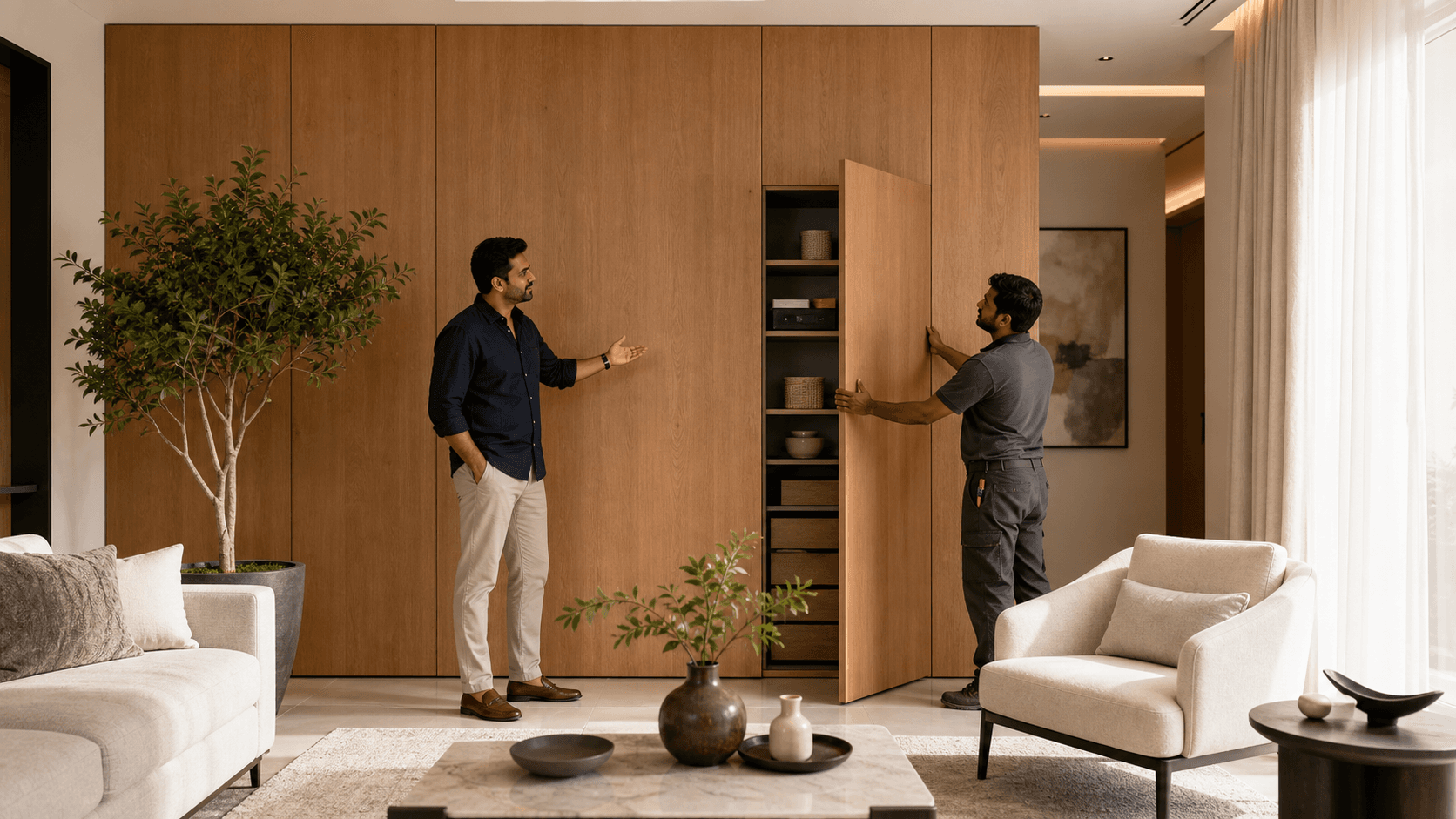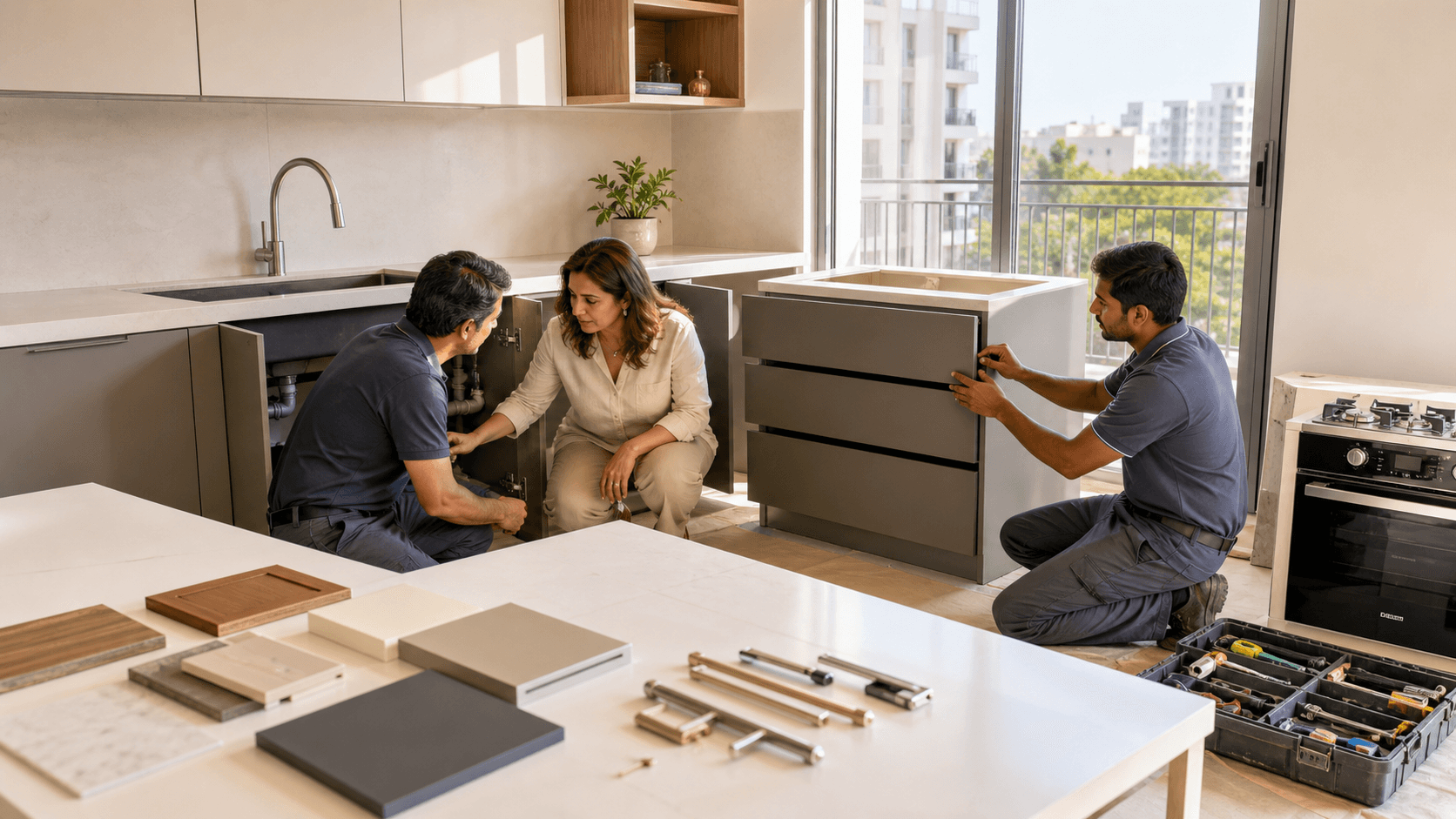
Why Apartment Modular Kitchens in Chennai Feel Risky
Planning a modular kitchen in an apartment in Chennai often feels stressful. There are society rules that no one explains clearly, surprise plumbing or shaft issues that show up after work starts, appliances that do not fit the cabinets, and handover snags that are spotted only after you have paid. Many homeowners worry that a simple kitchen can suddenly turn into weeks of rework and extra cost.
In our experience with new homeowners in OMR's gated communities, ECR villas, and older city apartments, the real problem is not only design. It is uncertainty: unclear building rules, ambiguous pricing, vague warranties, and no single person clearly accountable for the final outcome.
Apartments in Chennai come with their own set of limits. Builder floors, OMR gated communities, and older city apartments usually have fixed shafts, fixed wet areas, and strict association rules. Unlike independent homes, you cannot freely move walls, open new windows, or shift the kitchen across the flat. That is why you need an apartment-focused checklist and a system-driven process before you sign on any modular kitchen package.
Below is a structured framework we use to de-risk apartment kitchens:
- Decode rules and builder scope
- Lock services and layout
- Freeze appliances and electricals
- Demand pricing and warranty transparency
- Run a snag-based handover checklist
Each step reduces decision fatigue and removes a layer of uncertainty.
1. Decode Your Apartment and Society Rules First
Before any design, understand what you are allowed to change and what is fixed.
Start with the building or association guidelines. In many Chennai apartments, common rules include things like:
- No expanding the wet area beyond a defined line
- No shifting the sink far from the original plumbing point
- Limits on ducting through the external wall or into the shaft
- No drilling beams or columns
- Basic fire safety requirements around hobs and cylinders
Look for these rules in:
- Your welcome kit from the builder or association
- Builder handover documents and drawings
- Notices posted in the lobby, lift, or association office
Take clear photos or scans of all relevant pages and share them with your designer. Do not rely on memory.
Next, separate builder deliverables from interior work. Many Chennai builders hand over:
- A basic granite countertop
- A stainless steel sink and tap
- Dado tiles on two or three sides
- A few electrical points above and below the counter
Your checklist here should cover:
- What you are allowed to remove or replace
- Who will patch tiles or walls if items are removed
- Whether the builder will support changes during the defect liability period
Also, understand society processes for work approvals. Most apartments require:
- Work permission forms submitted in advance
- Daily or weekly gate passes for workers and materials
- Lift booking for heavy modules
- Strict work timings and limited or no work on weekends
These approval steps can easily push your kitchen timelines. Your modular kitchen package should include realistic lead times (including permissions and site work), not just the factory production time. When the same team handles end-to-end turnkey execution, from design to permissions support to installation, timeline accountability becomes much clearer.
2. Shaft, Plumbing, Gas and Layout Checks
In apartments, the shaft and plumbing decide half your kitchen design even before you select a finish.
A shaft in Chennai apartments is usually the common vertical duct where all water, drainage and sometimes gas or AC lines run. Its location fixes where your sink, dishwasher and sometimes washing machine can go. When you inspect your kitchen, check:
- Number of water inlets and outlets
- Height and exact position of outlet points
- Size and access to the shaft opening
- Whether the floor slope supports good drainage without backflow
- Any noise control rules for washing machines near bedrooms
Once you know the wet side, plan practical layouts. For narrow kitchens, parallel or single-wall with smart tall units work well. For squarish spaces, L-shaped or C-shaped layouts can be used, but always respect fixed plumbing points. Problems often happen when:
- The sink is moved too far from the shaft
- Long horizontal drain runs are created without gradient
- Tall units block shaft doors or inspection hatches
On gas, apartment kitchens usually have either piped gas from the builder or cylinder-based systems. Check your agreement and ask your association where cylinders can legally sit. In many complexes, cylinders are not allowed in the corridor.
A quick safety checklist:
- Adequate ventilation near the hob
- Correct hob cutout size in the countertop as per brand
- Safe distance between open flame and nearby plug points
- Reserved space for future chimney ducting or external vent
All this should be confirmed before finalizing the cabinet sizes and countertop. A system-driven design process will log these constraints in writing and reflect them in the drawings so that there is clear execution accountability on site.
3. Appliance Compatibility Inside Modular Kitchen Packages
One big reason for rework is late appliance decisions. It is better to freeze your appliance list before design starts. For most first-time apartment homeowners in Chennai, the minimum list includes:
- Chimney brand and type
- Hob size and number of burners
- Built-in or countertop microwave and oven
- Refrigerator size and door type
- Dishwasher yes or no, and width
- RO unit and any pre-filters
These choices change tall unit size, shutter opening style, internal accessories and even the electrical load plan.
Use a simple dimension checklist:
- Refrigerator width, height and space needed for door swing
- Oven and microwave cavity height, width and ventilation gap
- Chimney height range from the hob to the filters
- RO depth under the sink or in a nearby cabinet
- Dishwasher clearances for door opening and pulling out racks
On electricals, confirm:
- How many 15A and 5A points you need
- Separate MCBs for heavy appliances like oven and dishwasher
- Load on your inverter if you want the fridge or some lights on backup
- Switch placement so they are not too close to heat or water
Since Chennai is hot and humid, materials and hardware in your modular kitchen should handle moisture and regular cleaning. Heat and humidity can affect cheaper boards and low-quality hinges. Power fluctuations in some corridors also mean you should plan surge protection and reliable wiring for kitchen appliances.
Insist on branded boards, hardware and accessories with clear model names mentioned in your quotation and invoices. This not only improves performance, it also makes warranty and future replacements straightforward.
4. Pricing Clarity, Hidden Apartment Costs and Warranty Transparency
Many homeowners feel anxious because kitchen prices are presented as one big number. For clarity, it helps when costs are broken into simple heads like:
- Base and wall cabinets
- Shutter finishes
- Countertop and dado work
- Internal accessories like baskets and pull-outs
- Appliances
- Installation and site work
Always ask for an itemized quotation rather than a single lump sum for modular kitchen packages in Chennai. This lets you see which choices change the cost and by how much, and it reduces the feeling that you might be overcharged.
A simple way to assess quotes is to use a basic cost-structure table like this:
Component | What to Check
Cabinets (base & wall) | Running feet, board type & thickness
Shutters & finishes | Laminate / acrylic / PU, edge banding
Countertop & dado | Material, thickness, cutting charges
Accessories | Brand, model, quantity
Appliances | Separate line items, brand & model
Site work & services | Electrical, plumbing, debris, protection
Before you finalize any quote, clarify:
- Exact inclusions and exclusions
- Brand names for boards, hardware and accessories
- Board thickness and type
- Details of soft-close hardware and where it is used
Apartments often have smaller hidden costs that can surprise you later, such as:
- Debris removal and floor protection
- Lift usage charges if the association applies them
- Minor civil work, like chopping the counter or re-tiling a small area
- New or shifted electrical points and false ceiling cutouts
These should be discussed upfront. A transparent pricing model puts these apartment-specific costs either into the main quote or into a clearly written optional scope, so there are no last-minute add-ons.
Warranty and service terms matter even more in apartments, where kitchens see high, daily use in compact spaces. Ask about:
- Warranty period on boards, shutters, hardware and accessories
- Whether there is a long-term modular warranty (for example, 15 years)
- Whether the first few years include a 100% replacement guarantee with no hidden conditions
- Replacement timelines if a part fails
- On-site service response time after you raise an issue (for example, within 24 hours for service calls in Chennai)
- Written documentation of all warranty and service conditions, without fine-print clauses that dilute coverage
When warranties are simple, written in clear language and backed by branded products only, it becomes much easier to trust that your kitchen will be supported for the long term.
5. Handover Snag List and Turning It Into a Strong Brief
Before making the final payment, walk through the space with a clear snag checklist. Functionally, test:
- Shutter and drawer alignment and soft-close
- Clearances near walls, windows and doors
- Stability of tall units and open shelves
- Loft access for cleaning and storage
For utilities, check:
- All appliances switched on and tested
- Water flow and drainage with a real load of water
- Leak test at all joints under the sink and near the RO
- Hob ignition and chimney suction at different speeds
Then inspect finishes and detailing:
- Surface quality of laminates or paint, no bubbles or chipping
- Edge banding properly fixed and smooth
- Silicone sealing around the sink and wet areas
- Grout finish on dado tiles and alignment of cutouts on countertops
- Under-cabinet lighting, visible wires and properly sealed junction boxes
Finally, collect your documentation:
- Final drawings, including any changes made on site
- Marked electrical and plumbing changes
- Warranty cards and brand invoices
- A clear service contact, response timelines and process
Live with the kitchen for a week or so before closing the file mentally. Note small snags like a door rubbing, a minor alignment issue or a slow drip. These are normal in apartment projects and should be covered under the agreed service norms, ideally with quick response and closure.
Once you have gone through all these points, turn your notes into a written brief before you meet any interior firm. Include your society rules, builder handover details, shaft and plumbing conditions and appliance list. This single document reduces confusion, limits cost surprises and helps your designer build a modular kitchen proposal that respects your apartment, your routine and your comfort level with risk.
At Interiors by DeX in Chennai, we structure our system around this kind of clarity: transparent, itemized pricing; long-term modular warranties without hidden clauses; use of branded products only; and accountable, end-to-end execution from first drawing to final snag closure. If you are planning an apartment kitchen in Chennai and want the process to feel calm and predictable rather than stressful, start with a structured brief and speak to a team that can walk you through each of these steps in detail.
FAQs: Apartment Modular Kitchens in Chennai
How Early Should I Plan an Apartment Modular Kitchen in Chennai?
Ideally, start 8, 10 weeks before you expect possession. This gives time to decode rules, finalize design, issue a transparent quotation and plan installation around association timings.
2. Can I Re-Use the Builder Countertop and Sink?
Often yes, but it depends on their quality and your new layout. Clarify who will remove, refit or modify the countertop and who is responsible for any tile or wall patching.
3. Are Modular Kitchen Warranties the Same Across All Brands?
No. Some offer only hardware warranties, others cover boards and shutters. Look for a clear modular warranty (for example, 15 years) and simple language on replacement, especially in the first few years.
4. Why Do Chennai Apartment Kitchens Often Have Extra Site Costs?
Association rules, lift restrictions, debris policies and existing builder work all add small site-level tasks (protection, cutouts, and minor civil work) that are not obvious in a factory-only quote. Ask for these to be listed clearly.
5. How Can I Avoid Decision Fatigue When Choosing Finishes?
Work with a structured selection process: 2, 3 curated finish combinations, shortlists of proven accessories that work well in Chennai conditions, and mock-ups when required. A system-driven approach keeps choices manageable without compromising on quality.
Transform Your Everyday Cooking With a Smarter Kitchen Today
If you are ready to upgrade your space with a kitchen that truly works for your lifestyle, Interiors by DeX is here to help. Explore our curated modular kitchen packages in Chennai designed for efficiency, style, and long-term value. Share your floor plan and requirements, and we will guide you with personalized design options and transparent pricing. Have questions or want to schedule a design consultation? Simply contact us and we will walk you through the next steps.