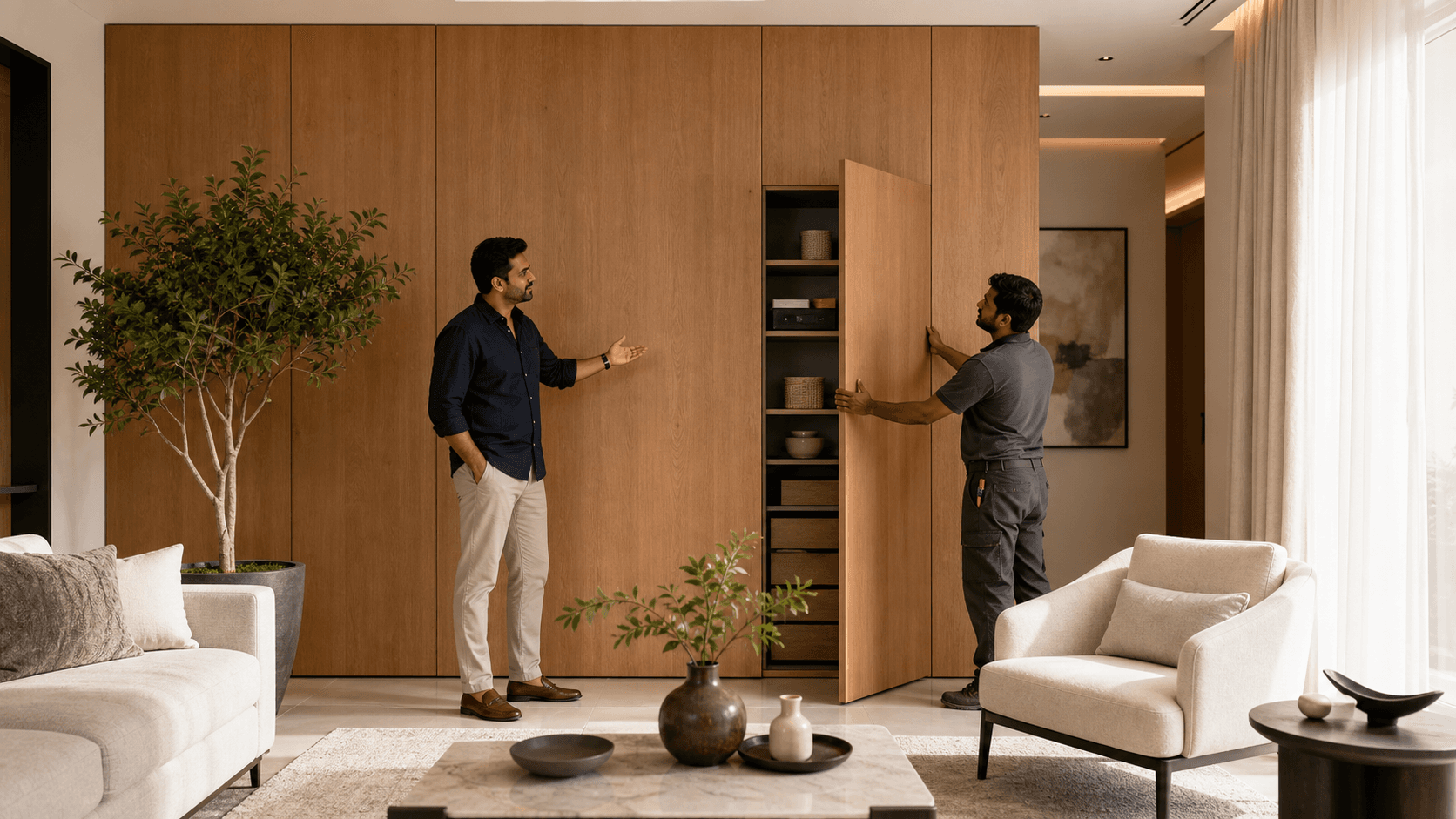
Why Your Execution Model Matters for Your Chennai Villa
For many new villa owners in OMR, ECR, Medavakkam, Sholinganallur or Perumbakkam, the most stressful part of interiors is not the colours or the finishes. It is the uncertainty: different quotes, different scopes, and no clear way to compare them. You worry about being overcharged, misled, or stuck in delays with no one clearly accountable.
In a Chennai villa, that uncertainty can get amplified. You are dealing with more square footage, more custom storage, more civil changes, and services like HVAC, basic automation, and sometimes terrace landscaping. One unclear decision on how you execute the work can mean months of delay, surprise costs, and finger-pointing between vendors.
This article breaks down three execution paths using four clear lenses: risk, accountability, cost control, and timeline. Turnkey interiors in Chennai is one strong option, but not the only answer. The goal is to give you a calm, structured way to choose a model that fits your life, your villa, and your comfort with risk.
Turnkey, PMC, or Multi-Vendor: What They Really Mean in Chennai
Let us start with simple, ground-level definitions.
Turnkey
One firm handles design, modular products, site execution, and coordination with your builder and other vendors, under a single contract. You have one main point of contact and one consolidated bill. In a system-driven turnkey model, you also get transparent pricing, instant quotations for clearly defined scopes, written warranties, and defined after-sales processes.
PMC (Project Management Consultant)
A designer or consultant prepares drawings, helps you select contractors, and oversees site quality. You still sign separate contracts with each contractor for carpentry, civil, electrical, and others, and payments and legal responsibility remain with you.
Multi-Vendor Self-Managed
You or a family member directly manage a designer, carpenter, modular vendor, electrician, plumber, false ceiling team, and painter, each with separate discussions and payments. You coordinate day-to-day work and handle conflicts between vendors.
Now fit this into a typical Chennai gated villa in Navalur or Siruseri. The association may:
- Allow work only from 9 am to 6 pm
- Restrict noisy work on Sundays
- Require visitor entries to be pre-registered
- Disallow use of lifts for debris
How each model handles that is different:
- Turnkey Teams usually handle gate permissions, visitor management, and sequencing across trades as part of a defined process. Accountability and timelines sit with one team.
- A PMC reminds and coordinates, but rule compliance still depends on each contractor actually following instructions.
- In a Self-Managed Setup, every missed permission or misunderstood rule is another day lost, and you have to resolve it.
Premium turnkey interiors in Chennai today often work with system-driven processes: transparent BOQs (Bill of Quantities), instantly generated quotations for standard scopes, written warranties on modular products with no hidden clauses, and committed after-sales response. This is very different from old-school, fully contractor-led setups, and it changes how much uncertainty you carry as a homeowner.
A Simple Framework: Risk, Accountability, Cost, Timeline
To compare models, it helps to use four clear lenses and rate each model for your own situation.
# 1) Risk
Think of risk as the chance that you will face:
- Cost overruns
- Time overruns
- Quality or callback issues
For example, if a wardrobe door warps in peak monsoon humidity in Sholinganallur, or if there is seepage around a window after a false ceiling, ask:
- Who takes responsibility to fix it?
- Is there a written warranty covering the issue, with clear terms and no hidden clauses?
- How many different vendors might be involved in blaming one another?
In a turnkey model with branded materials and documented warranties, this risk is concentrated with one firm. In a multi-vendor or PMC model, it is spread across multiple contractors and may fall back on you when responsibilities are not clearly defined in writing.
# 2) Accountability
Accountability is how easily you can say, "This is your responsibility, please fix it," and expect a structured response.
- With One Integrated Turnkey Team, there is less scope for "That is the carpenter's mistake, not mine." If design, modular manufacturing, and site execution sit with one firm, execution accountability is clearer.
- With a PMC, the consultant can highlight issues and escalate, but the legal and financial relationship is between you and each contractor.
- With Multiple Vendors, blame can bounce around while you stand in the middle, especially when there are overlaps between trades (for example, false ceiling and electrical, or carpentry and painting).
# 3) Cost Control
Cost control is about:
- How clear the scope is
- How changes are handled
- Whether pricing is itemized and transparent or vague and lump-sum
In a Transparent Turnkey System:
- You typically receive a detailed, line-item BOQ with itemized pricing.
- Instant quotations can be generated for common villa configurations (for example, 3BHK + family lounge + work-from-home room), so you have early visibility on budgets.
- Change requests go through a defined process, with revised BOQs and clear approvals, reducing the chance of surprise bills.
In a Multi-Vendor Setup, you might get lower starting numbers, but additions like extra electrical points, packing plywood, site protection, or debris removal can appear late. Without a system-driven pricing model, it is harder to track what changed and why.
# 4) Timeline
Timeline is not only "how many days," but also:
- Predictability of start and finish
- Gap between promised and actual dates
- How one delayed trade affects the next
Many villas in Thoraipakkam or Karapakkam slip by months because one vendor delays by a week, then everyone else reschedules, and the whole sequence breaks.
A simple comparison table you can sketch for yourself:
- Rows: Turnkey, PMC, Multi-vendor
- Columns:
- Risk Level
- Accountability Clarity
- Cost Visibility (itemized vs lump-sum)
- Timeline Predictability
- Ideal For (busy IT couple, retired owner, NRI, etc.)
Rate each from Low to High based on your comfort and the time you can personally invest.
How Turnkey Interiors Typically Perform in Chennai Villas
Turnkey interiors concentrate both risk and accountability with one firm. That is the main trade-off. For many first-time interior clients, this also significantly reduces decision fatigue.
# Risk and Accountability
- You have one team responsible for design, modular products, execution, and coordination.
- You avoid conversations like "The false ceiling person blocked my access" or "The carpenter used the wrong hardware, not me."
- When the turnkey firm uses only branded products and backs them with written warranties that clearly state coverage and duration, you reduce unknowns like laminate peeling or poor hardware performance in coastal humidity around ECR and Akkarai.
# Cost Clarity and Transparent Pricing
Systemized turnkey interiors aim to reduce uncertainty around budgets:
- They often start with instant quotations for standard villa patterns, so you have an early view on the cost band.
- A detailed BOQ with locked specifications at the start means every cabinet, channel, and finish is documented.
- The pricing model is transparent: item-level rates, clear inclusions and exclusions, and no hidden clauses linked to the warranty or after-sales.
- Changes go through a defined change-order process, with written confirmation of cost and timeline impact before work proceeds. This makes creeping bills less likely than in loosely scoped contractor quotes.
# Timelines in Local Conditions
- A single schedule owner can plan civil changes, electrical, false ceiling, and modular installation to run in sequence within association rules in Perungudi or Pallikaranai.
- Material and labour planning sit with one team, so shortages and "electrician did not come today" situations are easier to control.
- A system-driven schedule can also factor in local realities: monsoon slowdowns, festival breaks (Pongal, Deepavali), and traffic patterns between OMR and ECR that affect labour movement.
In well-structured turnkey systems in Chennai, you will typically see:
- Clear timelines shared upfront
- Milestones tied to design freeze, site start, modular production, installation, and handover
- Visibility into what happens if there is a delay, and who is accountable
# How Some Turnkey Systems Reduce Long-Term Anxiety
Some turnkey interior firms in Chennai structure their offering specifically around reducing uncertainty for villa owners who travel or work late hours in OMR tech parks, by providing:
- 15-Year Warranty on Modular Products, documented with clear terms
- First 5 Years: No-Conditions Replacement Guarantee on modular components, so you are not debating causes for early failures
- Use of Branded Products Only, to ensure predictable performance in Chennai's coastal climate
- 24-Hour After-Sales Response, so you know whom to call and what to expect if something comes up later
These elements, when clearly written into the agreement without hidden clauses, shift ongoing risk and accountability away from you and onto the system.
When PMC or Multi-Vendor Can Make Sense
The PMC model can suit owners who want more control but still need a professional eye on quality and basic coordination.
# PMC: Advantages and Realities
- You get design support and someone to check if a contractor's work matches drawings.
- You can choose your own carpenter or tiling team and negotiate rates directly.
- You may achieve savings if you are disciplined about scope and changes.
- However, contracts and payments are still in your name. If a tiling contractor delays or disputes scope, the PMC can escalate and recommend, but formal enforcement is your responsibility.
This model usually works better when at least one family member is comfortable with drawings, BOQs, and site discussions.
# Multi-Vendor Self-Managed: for a Specific Profile
The multi-vendor route typically fits only a certain type of owner:
- You or a family member can be at site often.
- You are comfortable reading drawings and BOQs.
- You have some past exposure to construction and are okay taking firm calls.
- You accept higher variability in cost and time in exchange for granular control.
Chennai-specific challenges here include:
- Coordinating a carpenter, a modular factory (sometimes based in another city), electrician, POP worker, and painter through monsoon days, waterlogging, and festival breaks around Pongal or Deepavali.
- Handling rework if one trade damages another's work, like a carpenter scratching fresh paint or an electrician opening a finished false ceiling.
- Watching how "cheaper per square foot" quotes can grow once you add rework, extra visits, last-minute lofts or a larger puja unit, or additional weather-protection coats in coastal belts like Injambakkam or Uthandi.
For villa owners who have limited time and want predictable outcomes, the risk profile of this model can feel high.
Cost, Time, Risk, and Lifestyle: Putting It All Together
Take a reference case: a 3BHK villa off OMR with a study, family living area, full modular kitchen, wardrobes, TV units, and basic civil works.
You can think of the three models like this, without getting into exact prices:
- Turnkey: Often a higher headline number, but usually includes design, modular products, site execution, coordination, and structured after-sales, which limits surprise items later. Transparent pricing and instant BOQ-based quotations make it easier to plan.
- PMC: You pay a professional fee plus separate contractor bills. You might save if you are strict on scope, but you carry higher variance risk in both cost and time, and you handle more of the enforcement.
- Multi-Vendor: Can look lowest at the start, but tends to add hidden or unplanned pieces: extra electrical points, debris removal, site protection, additional coats of paint in humid weather, and late-stage storage additions.
A simple table you can sketch for yourself:
- Columns:
- Model
- Approximate Cost Band (relative: Highest / Medium / Lowest on paper)
- Typical Variance From Initial Quote (Low / Medium / High)
- Average Completion Time (Fast / Medium / Slow, for your lifestyle)
- Common Hidden or Late-Added Costs (list a few you are likely to face)
Also think in terms of Risk-Adjusted Cost:
- Extra rent in Adyar or Velachery if handover slips by a few months
- Weekly trips from OMR offices to site, which cost time and mental energy
- Major repairs within five years if low-quality materials were used without strong warranty support and clear after-sales
Weather and Lifestyle
matter too. Coastal humidity in ECR, Injambakkam, or Akkarai means material choice and hardware quality are more important than they look on paper. Monsoon months can slow drying times and site access. A well-planned turnkey schedule usually builds these into the plan, while a loose multi-vendor setup often reacts on the fly.
Finally, check your own profile honestly:
- Time: How many hours a week can you give to site or calls?
- Experience: Have you done construction or interiors before?
- Risk Tolerance: Are you okay if final cost and time are not very predictable?
- Detail Comfort: Can you calmly read drawings and line-item BOQs?
- After-Sales Expectation: Do you expect a structured, time-bound response when things come up later, or are you comfortable coordinating different people each time?
A busy IT couple living on rent, with high pressure at work and low patience for delays, usually benefits from a strong, system-driven turnkey structure with clear timelines and documented warranties. A Chennai-based family with an engineer who enjoys being onsite may be happier with PMC or even multi-vendor. NRIs and outstation owners usually find turnkey interiors in Chennai, with transparent pricing, written warranties, and defined after-sales, to be safer and less stressful.
Quick FAQs for Chennai Villa Owners
1. Is Turnkey Always More Expensive Than a Contractor-led Approach?
Not necessarily. The upfront number can be higher, but it usually includes design, coordination, branded materials, warranties, and after-sales. When you add hidden or late-stage costs in a contractor-led setup (extra electrical points, rework, delays extending rent), the total outflow can become comparable.
2. How Do I Verify That Pricing Is Truly Transparent?
Ask for a detailed BOQ with item-level rates, clear inclusions and exclusions, and a written change-order process. Check that warranty terms are documented and not dependent on vague conditions.
3. What Should I Look for in a Warranty for Chennai's Climate?
Look for written coverage on modular products for at least 10, 15 years, clear mention of hardware brands, and no hidden clauses related to normal humidity or coastal conditions. Also check response timelines for after-sales.
4. Can a PMC Model Work If I Am an NRI or Living Outside Chennai?
It can, but only if you have a trusted local representative and are comfortable making decisions remotely. In many NRI cases, a well-structured turnkey system with clear accountability and after-sales is operationally simpler.
5. How Early Should I Decide My Execution Model?
Ideally before detailed design starts. The execution model impacts how drawings are prepared, how BOQs are structured, and how timelines are planned with your villa association and builder.
A Grounded Next Step
If you are planning interiors for a Chennai villa and are unsure which execution model fits your situation, start by mapping your time, risk comfort, and need for predictability against the three options using the simple tables suggested above.
At Interiors by DeX in Chennai, our turnkey system is designed around removing uncertainty: transparent BOQs and pricing, instant quotations for clearly defined scopes, a 15-year warranty on modular products with a no-conditions 5-year replacement period, use of branded products only, and 24-hour after-sales response. The focus is to keep accountability clear, timelines structured, and decisions simpler, so you can spend less time managing a site and more time planning how you will actually live in your new villa.
Whether you choose turnkey, PMC, or a multi-vendor route, approaching the decision with this framework will help you reduce ambiguity and make a choice that matches your life in Chennai, not just the numbers on a quote.
Get Started With Your Project Today
If you are ready to transform your space with a single, streamlined solution, explore our specialized turnkey interiors in Chennai to see how we handle everything from concept to completion. At Interiors by DeX, we take care of design, materials, execution, and finishing so you can focus on enjoying the results. Share your requirements and timeline with us, and we will tailor a plan that fits your style and budget. If you have questions or want a consultation, simply contact us to get started.