Decision Fatigue in Chennai Home Interiors
For many new homeowners in Chennai, interiors start with excitement and quickly turn into uncertainty. New keys, new space, but then: too many choices, too many vendors, too many versions of the final price. You are never fully sure what you are getting, or what it will finally cost.
This mental drain is decision fatigue. It builds up when you have to keep taking small and big decisions without clear, reliable information. In home interiors, especially in Chennai's fast-paced IT corridors and growing gated communities, this happens often.
In this article, we break down why decision fatigue shows up so strongly in Chennai interiors, and how a clear, system-driven turnkey model, with transparent pricing, defined timelines, and accountable after-sales, can make the whole process calmer and more predictable.
Why Chennai Homeowners Feel Drained by Interior Decisions
A typical Chennai homeowner today might have:
- A new flat on OMR with a demanding IT job
- A sea-facing apartment closer to ECR, dealing with coastal air
- A villa in a gated community along the city's expanding corridors
Workdays are long, traffic is heavy, and site visits often mean early mornings, late evenings, or sacrificing weekends. In between, there are family needs, school runs and basic life admin.
On top of this, interior work throws up hundreds of choices:
- Laminates, finishes, edge bands, handles
- Plywood grades and brands
- Wardrobe layouts and internal accessories
- Appliances, lights, switches, soft furnishings
Decision fatigue is simple: your brain gets tired of choosing, especially when:
- Information is unclear
- Pros and cons are not explained in plain language
- Every vendor says something different
You keep second-guessing. For Chennai, there are extra layers: fighting traffic to visit multiple showrooms, speaking with contractors who may not explain details, and trying to judge what is "good enough" for heat, humidity and coastal air.
Where Decision Fatigue Starts in Chennai Interior Projects
Most of the mental load starts right at the beginning, when scope, pricing, timelines and accountability are not clearly defined.
Common triggers are:
- One vendor for design, another for carpentry, another for electrical
- False ceiling and soft furnishings handled by separate teams
- No single, complete drawing set that everyone follows
Work then proceeds with constant changes on site. Homeowners try to track messages, calls and verbal promises. It becomes difficult to remember what was agreed and what actually gets executed.
Pricing Confusion: the Biggest Source of Stress
Many Chennai homeowners are specific about one fear: "Am I being overcharged?" That anxiety grows when they see:
- Estimates with missing line items
- Vague "extra" charges during execution
- Site-level negotiations with no written backup
Comparing two quotes becomes a headache:
- One includes hardware, another does not
- One counts lofts inside wardrobe rates, another shows them as "optional"
- Units are measured differently, so running foot and square foot numbers do not line up
When you do not have a transparent pricing model with itemised BOQs and clear unit rates, every change feels risky. You are never sure what the final number will look like.
Product Doubt in Chennai's Climate
There is also product confusion, especially with Chennai's heat, humidity and coastal conditions:
- Local hardware vs branded hardware
- Different plywood grades and brands
- Modular units vs carpenter-made on site
Common questions are:
- Will this swell in humidity?
- Will this rust near the coast?
- Will termites be a problem in this locality?
When answers are incomplete or contradictory, you end up stuck between options, revisiting the same decision repeatedly.
How a Turnkey, System-Driven Model Reduces Mental Load
A well-run, end-to-end turnkey system brings everything under one accountable team. That single change removes a large part of the uncertainty.
Instead of coordinating multiple carpenters, electricians, false ceiling teams and soft furnishing vendors, you have:
- One point of contact
- One design and drawing set
- One team responsible for both materials and workmanship
The process becomes system-driven rather than personality-driven. A typical structured workflow looks like:
- Brief: Understanding family needs, lifestyle, and a realistic budget band
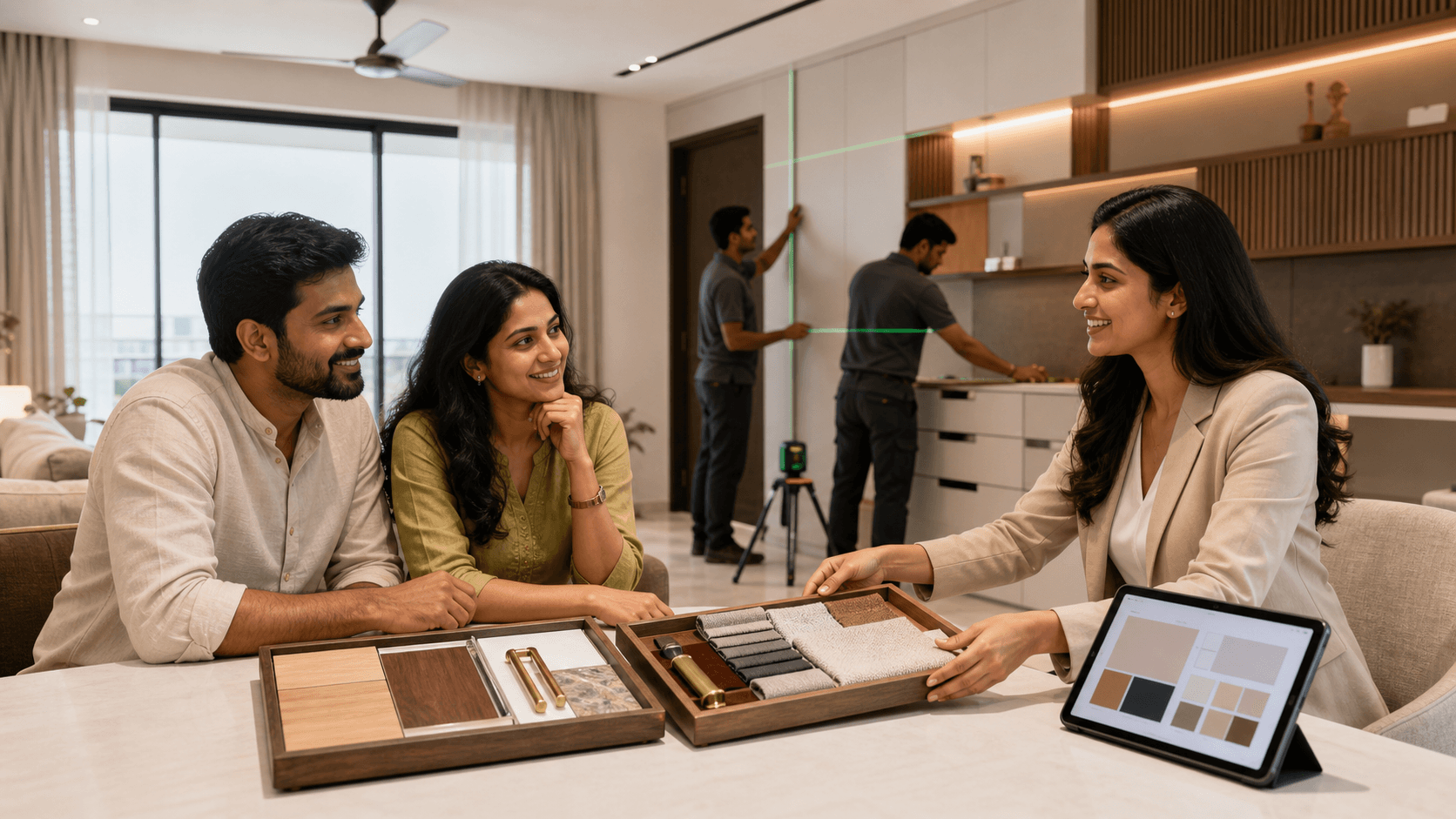
- Concept: Layout options and overall look-and-feel, so you see how spaces will function
- Detailed Design: Exact measurements, 3D views, and technical drawings for each room
- Approvals: Locking design, materials and specifications before production
- Production: Factory manufacturing of modular units and backend planning
- Installation: On-site fitting, finishing, and final quality checks
When these stages are fixed, you are not forced into fresh decisions every day on site. You take a few bigger decisions at the right time, with complete information in front of you.
Transparent Pricing: Seeing the Full Picture Upfront
A systemised turnkey model should include transparent pricing as a core feature. That means:
- Structured, instant quotations based on internal rules applied to every project
- Itemised estimates rather than lump-sum numbers
- Clear unit rates for each type of unit
- Written inclusions and exclusions with no hidden clauses
A simple, Chennai-relevant structure for a premium home might look like:
Area
Typical Unit
How It's Priced
What's Clearly Defined
Core kitchen
Base + wall units
Per running foot
Carcass material, shutter finish, hardware brand & range
Wardrobes
Sliding / hinged
Per square foot
Internal layout options, lofts, mirror, accessories
TV unit
Base + wall panels
Per running foot
Storage volume, panel material, back-panel treatment
With this structure, you can adjust quantity or feature level without feeling blind. Changes in scope translate into clear, written cost and timeline revisions instead of vague adjustments.
Clear Warranty and After-Sales: Less Worry About Every Choice
Warranty is another area where uncertainty usually creeps in. Many homeowners are used to hearing verbal promises without clear documentation.
A system that aims to remove doubt will have:
- A written 15-year warranty on modular products
- The first 5 years covered under a 100% replacement guarantee, no questions asked
- No hidden clauses or complicated fine print
When you know upfront that if a shutter bends, a panel swells in humidity, or a modular component fails in normal use, it will be repaired or replaced within these clear terms, you do not need to obsess over every micro-choice.
After-sales timelines matter just as much as project timelines. Instead of open-ended promises, a mature turnkey system will commit to:
- 24-hour after-sales response for service tickets
- Documented process for logging, tracking and closing issues
For busy IT professionals on OMR or homeowners who travel frequently, this means the home keeps working in the background without constant follow-up calls.
Branded Products and Chennai's Climate
In Chennai, branded materials and hardware are not just a premium choice; they directly impact durability in heat and humidity.
A system-driven interior provider will typically:
- Specify branded plywood, laminates and hardware by name in the BOQ
- Choose products tested for humid and coastal conditions
- Avoid mixing local, unbranded items into a supposedly "premium" specification
This clarity helps you understand exactly what you are paying for, and why it is suitable for Chennai's weather.
What a System-Driven Turnkey Process Looks Like in Chennai
In a Chennai context, a thoughtful turnkey process respects both climate and lifestyle.
A typical workflow can include:
- Discovery: Family size, work patterns, storage for monsoon gear, extra gas cylinders, water cans and daily-use items
- Utilities Planning: Inverter and DB positioning, AC outdoor unit placement, ventilation in compact kitchens, provisions for RO and washing machine in utilities
- Balcony and Utility: Clothes drying, plants, small seating, water drain points and railing treatments suitable for coastal air
Design happens with 2D layouts and 3D visuals so you can see how the home will work before anything is built. Material selection is handled in a curated way, with limited but well-considered options that suit coastal humidity and everyday use, rather than endless catalogues.
Execution stays disciplined when there is:
- A milestone-based schedule aligned with your builder's handover date
- Awareness of society rules for work timings and lift usage in Chennai's gated communities
- Regular site supervision and documented quality checks
Seasonal and cultural rhythms are also considered. Heat waves, early monsoon showers, and festival timelines like Pongal and Deepavali are factored into planning so you are not stuck with civil work during a family gathering.
Reducing Your Decision Load Without Losing Control
Many homeowners worry that a turnkey model means losing control. In practice, a good system helps you control the big picture while offloading the small, tiring choices.
You stay in charge by:
- Setting clear style direction: warm, minimal, classic, etc.
- Fixing a budget band and priority spaces (for many, kitchen and wardrobes first)
- Sharing material preferences, such as always choosing branded hardware and specified finishes
From there, the design team can curate 3, 4 focused options for each key decision instead of leaving you to scroll through hundreds. You still choose, but from a narrowed, sensible set designed for Chennai conditions.
When you talk to any provider of turnkey interiors in Chennai, some useful questions are:
- What exactly does your scope include and exclude, in writing?
- How are your 15-year modular warranty terms written, and how are claims handled in the first 5 years of 100% replacement?
- What is your documented after-sales response time? Is it within 24 hours?
- Do you only use branded products? Are they listed clearly in the BOQ?
- How do you handle design or scope changes mid-project, and how do you share updated costs and timelines?
Turnkey interiors tend to suit:
- First-time homeowners who do not want to coordinate multiple vendors
- Busy professionals in the IT corridor with limited time for site visits
- Villa and gated community buyers who prefer one accountable team
For these profiles, the mental load of a fragmented, contractor-led approach usually does not feel worth the minor savings it might promise.
Moving From Overwhelm to a Clear Interior Plan
Feeling drained by interior decisions is normal, especially in a city like Chennai where work, traffic and climate already demand a lot of energy. When your project is split across many vendors, with unclear drawings, pricing and warranty, your mind stays on high alert.
A transparent, system-driven turnkey model cannot remove every decision, but it can sharply reduce the number of decisions you need to make, and the amount of doubt attached to each one. With clear pricing, documented timelines, branded materials, a 15-year modular warranty with the first 5 years fully covered, and 24-hour after-sales response, interiors move from being a source of stress to a managed process.
If you are a new homeowner in Chennai and want your interiors to feel structured rather than chaotic, it may be worth exploring a turnkey partner whose systems are built around clarity, transparency and accountability. The goal is simple: premium interiors with as little uncertainty as possible, so the home can settle into your life without becoming another full-time project.
Get Started With Your Project Today
Transform your home or workspace with Interiors by DeX and let our experts handle every detail from concept to completion through our specialized turnkey interiors in Chennai. We take the time to understand your lifestyle, budget, and design preferences so the final space feels personal and effortless. If you are ready to discuss ideas, timelines, or next steps, simply contact us and we will walk you through the entire process.