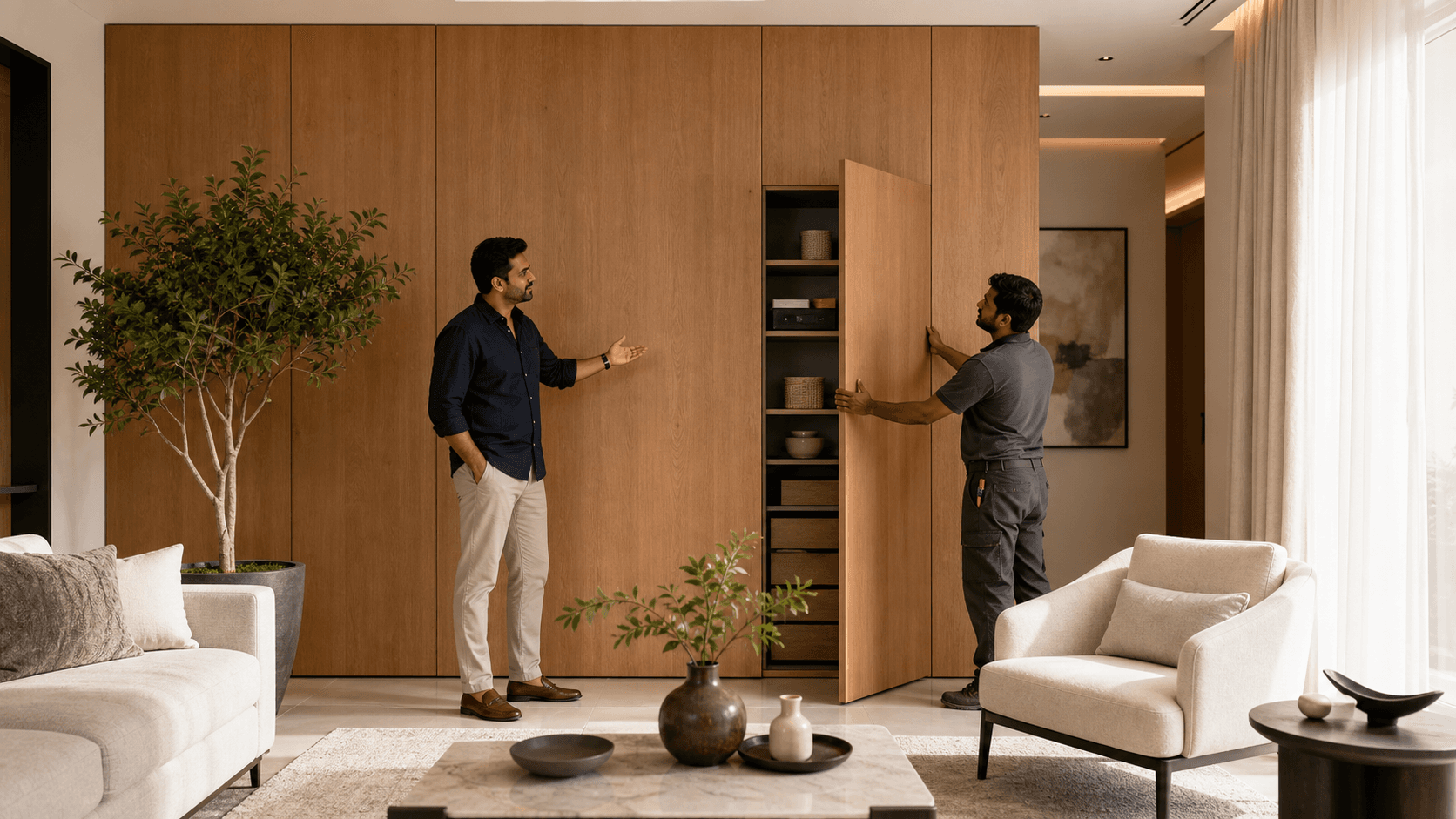
Why Scope Creep Breaks Chennai Home Interiors
Scope creep quietly breaks more Chennai home interior projects than bad design ever does. Work starts with a simple brief for a new flat in OMR or a villa near ECR, and everyone says the same thing: basic modular kitchen, wardrobes, TV unit, nothing fancy. Six months later, the handover date is close, the builder is chasing for parking stickers, you are still staying in a rented house, and the interior cost and timeline have somehow doubled.
For most Chennai homeowners, the real problem is not one big mistake. It is uncertainty: not knowing what is included, what will be charged extra, and whether the handover date will actually hold.
Scope creep is just this, in plain words: slow, unplanned expansion of work that is not matched by clear approvals, updated budgets, or revised timelines. It is not one big dramatic change. It is lots of small, casual decisions that are never written down properly.
First-time homebuyers in Chennai feel this more sharply because there is so much pressure around the home:
- Pre-EMI and rent running together
- Builder handover dates and association fit-out rules
- Tenancy deadlines and school term starts
- Extended family expectations about pooja, storage, guest rooms
On top of this, there is the local habit of saying "we will decide during execution." That usually means late-night WhatsApp messages, quick calls from office lifts along the IT corridor, and endless worry about whether you are being overcharged for every extra shelf.
Our aim here is to give you a simple, practical way to keep turnkey interiors in Chennai on budget and on time, without sacrificing the quality or comfort you want in your home, and to show how a structured system with transparent pricing and clear warranties removes that uncertainty.
How Scope Creep Starts in Chennai Apartments and Villas
Scope creep almost never starts with a grand design idea; it begins with small site realities.
Common triggers we see in Chennai homes include:
- Builder surprises, like beams cutting into wardrobes, bigger or smaller shafts, electrical points not matching the approved drawings
- Last-minute family inputs such as "add a pooja room," "make the wardrobe bigger," "shift the bed for better vastu"
- Carpenter-style comments on site: "this will look better if we just extend it a bit," "let us cover this niche also"
- Lifestyle shifts like wanting to enclose the balcony because of dust and heat, or adding extra storage for monsoon-related items
Monsoon timing, coastal humidity, and festival deadlines like Deepavali or Pongal often push rushed decisions. Work gets squeezed between flat possession dates and pooja dates. In that hurry, many changes are spoken, not written. Costs show up only at the end.
If there is no clear written scope and drawing set, every site visit becomes a negotiation. In many gated communities, different vendors do different parts: one for the kitchen, another for wardrobes, one more for false ceiling, and yet another for lights. Nobody owns the full picture, so every change hits something else.
The real truth is simple: scope creep is rarely one big extra room or a fancy imported item. It is dozens of small, undocumented decisions under pressure, all adding up quietly.
A Clear Scope Framework for Turnkey Interiors in Chennai
We find that Chennai homes stay far more stable when the scope is broken into simple layers. A four-layer framework works well:
- Layer 1: Fixed Scope, civil work, modular kitchen, wardrobes, TV unit, beds
- Layer 2: Semi-Flex Scope, loose furniture, lighting, mirrors, basic panelling
- Layer 3: Optional Add-Ons, bar unit, study room, balcony storage, guest room upgrades
- Layer 4: Out of Scope, structural changes, common area work, or anything that needs builder approvals that are not yet in place
For turnkey interiors in Chennai, the key is to lock Layer 1 and Layer 2 before work starts on site. Layer 3 stays as a clear, pre-costed menu, not a vague "we will see later" list. Layer 4 is documented as excluded, so you do not get surprise discussions midway.
Scope clarity documents should always include:
- Signed floor plan with dimensions
- Elevation drawings for all fixed furniture
- Brand list for boards, shutters, and hardware (branded products only)
- Finish schedule for colours and textures
- Electrical points and false ceiling layout
When all this is decided and signed, you are not re-opening the same decision every week. That alone cuts decision fatigue by a huge amount.
Another factor that calms things down is confidence in product life. When you know all modular items are branded and come with a 15-year warranty and a Clear, No-Conditions 100% Replacement Guarantee for the First 5 Years, with no hidden clauses, you do not feel the need to over-design or add extra backup storage "just in case something fails."
Transparent Costing to Stop Budget Drifts
Scope creep and budget creep are almost always twins, especially when pricing is given as one vague package rate. Many Chennai homeowners only see a single figure for the full home and are not sure what is included or excluded.
A transparent pricing model with instant, system-generated quotations tied to a detailed BOQ (bill of quantities) changes this completely. If each wardrobe, loft, and cabinet has its own line item, then any addition or deletion is easy to understand.
For example, for a 3BHK in OMR (kitchen + wardrobes only), the difference looks like this:
Approach
How It's Shown
Impact on You
Vague Package Quote
One combined amount, no clarity on running feet, brands, or finishes
Hard to know what you are paying for, difficult to downgrade/upgrade specific rooms
Transparent Line-Item Quote
Separate amounts for base units, wall units, tall units, each bedroom wardrobe, lofts, study tables, with brands and specifications clearly written
Any change in scope shows clear cost impact; no ambiguity about inclusions and exclusions
With this kind of quote, grey areas like "this was included" versus "this was extra" reduce sharply. Inclusions and exclusions are written in simple terms; for example, appliances, false ceiling, wallpapers, and loose furniture are clearly marked as separate.
In Chennai, typical extras that quietly slip in are:
- Extra lofts in utility or passage areas
- A tall unit for pooja storage
- Balcony cabinets to handle dust and salt air
- Extra drawers for work-from-home setups
Each of these should already have a pre-defined rate in the BOQ. When any variation happens, you sign a small cost impact sheet before work proceeds. Scope creep then becomes a conscious choice, not an accident.
Execution Systems That Keep Projects on Track
Even the best scope and quote can fall apart if execution is random. System-Driven Execution is what keeps interiors from going off track.
Strong systems usually include:
- Checklists at every stage, from site measurement to final finishing
- Written approvals before anything is sent to factory; no new layouts agreed only with a site supervisor
- Regular progress updates with photos and short milestone notes
End-to-End Turnkey Execution removes the common Chennai problem of too many vendors pointing fingers at each other. When one accountable team is responsible from design to installation and after-sales, coordination between electrician, modular units, and false ceiling becomes a process, not a daily fight.
Using only factory-made branded modular products also reduces on-site improvisation. Modules are designed to fit compact Chennai apartments and villas neatly, so there is less temptation to stretch, adjust, or extend on the fly.
After-sales reliability quietly lowers scope anxiety. If you know there is 24-hour after-sales service response for complaints and a clear 15-year warranty on modular products (with the first 5 years covered by a 100% no-questions-asked replacement guarantee), you do not need to overbuild or overspecify right now. You can keep the design clean, knowing issues will be fixed, not argued.
Timeline clarity is just as important. Documented start dates, factory dispatch dates, and handover milestones help you match possession dates, association working hours, and joining dates for new jobs along the IT corridor.
Practical Checklist to Avoid Scope Creep in Your Home
Here is a quick pre-execution checklist for Chennai homeowners:
- Have you frozen all rooms and functions, including pooja, utility, balcony, and any study or office?
- Do you have dimensioned drawings and 3D views for all fixed furniture?
- Are board, shutter, and hardware brands (branded products only) agreed in writing?
- Is your quote line-item based, with clear inclusions and exclusions?
- Are electrical and false ceiling layouts finalised with the furniture plan?
- Is there a documented process for handling changes and cost impacts?
- Is the warranty document shared, with duration, coverage, and exclusions clearly written, and no hidden clauses?
During execution, use a second checklist:
- Avoid approving layout changes directly with workers on site
- Make sure any material substitution is recorded with brand and price impact
- Hold weekly or milestone reviews, with written minutes or summary messages, not just verbal agreement
- Ensure any added unit or deletion is captured in a revised BOQ and cost impact sheet
These simple lists help first-time interior clients and busy IT professionals who cannot visit site often. Instead of reacting to ad hoc calls, you work with a clear, trackable system that keeps scope, cost, and time under control.
FAQs: Scope, Costs and Warranty for Chennai Interiors
Q1. Scope Creep Cost Increase for a 3BHK Project in Chennai?
There is no single number, but in many unstructured projects we see 15, 30% cost increase purely from undocumented additions. With a transparent, line-item BOQ and signed change notes, most of our Chennai clients keep variations within a range they have consciously approved.
Q2. How Do I Know I Am Not Being Overcharged for Extras?
Insist that every potential extra, like an additional loft or balcony cabinet, already has a pre-defined unit rate in your BOQ. Any change should be priced using that rate and shared as a short variation sheet before work starts. This removes negotiation from the site and keeps pricing transparent.
Q3. What Exactly Is Covered Under Your Modular Warranty?
All modular products (kitchen, wardrobes, storage units) come with a 15-year warranty. For the First 5 Years, there is a 100% Replacement Guarantee, no questions asked, with no hidden clauses. After that, issues are handled under the standard warranty terms, which are documented and shared in writing.
Q4. How Quickly Are Service Issues Attended to in Chennai?
Our system is built around 24-hour after-sales service response. Complaints are logged centrally, assigned to a service team, and tracked till closure. This is especially important for clients who are travelling or working long hours in the IT corridor and cannot keep following up.
Q5. Can I Phase My Scope Without Losing Control Over Budget?
Yes. Layers 1 and 2 (core modular and essential lighting) are usually executed before you move in. Layer 3 (optional add-ons) can be phased, but each item should still be pre-costed in your BOQ. That way, even if you decide to add a study or bar unit six months later, you already know the rate and specification.
Choosing a Partner Who Reduces Stress, Not Adds to It
To keep scope creep away, the partner you choose in Chennai matters as much as the design. Look for signs of structure, not just pretty 3D views. Things like instant, transparent quotations with detailed BOQs, clear documentation of scope, brands and finishes, a written change-approval system, and a clear warranty and service policy are all good signals.
A firm commitment to branded products with a 15-year modular warranty and a firm, no-conditions 5-year 100% replacement promise shows that the focus is on accountability, not excuses. Strong after-sales response, within clear timelines, means you are not left chasing multiple people later.
At Interiors by DeX, we have built our turnkey process around exactly these ideas: system-driven interiors, transparent pricing, and documented accountability. The goal is simple, premium interiors with clarity instead of confusion.
If you are planning interiors for a new flat in OMR or a villa in a Chennai gated community and want to understand scope, costing and timelines clearly, you can start with a floor plan discussion and an instant, line-item quotation. From there, everything, scope, price and execution, is kept visible, so decisions stay calm and informed, not rushed and uncertain.
Transform Your Space With Expert Turnkey Interiors Today
If you are ready to simplify your renovation journey and enjoy a cohesive, well planned home or workspace, our team at Interiors by DeX is here to help. Explore how our turnkey interiors in Chennai can handle every detail from concept to completion with clear timelines and accountability. Share your project requirements and design preferences with us, and we will propose a tailored solution that suits your lifestyle and budget. To discuss your ideas with our design team directly, simply contact us today.