Wardrobes That Survive Chennai Humidity, Not Surrender to It
Clothes smelling musty inside a brand-new modular wardrobe in Chennai is not normal, even if people keep saying it is just "our weather." Many homeowners move into a new flat, turn on the AC, and within a few weeks, shirts smell damp, saris feel sticky, and shelves start to swell at the edges. The wardrobe looks premium from the outside, but living with it is stressful.
For most first-time homeowners in areas like OMR, Sholinganallur, Perumbakkam, or Navalur, the real problem is uncertainty:
- You are not sure if the internal planning will work in Chennai's humidity.
- You do not know what exactly you are paying for inside the wardrobe.
- You are worried about hidden costs or failures after the first or second monsoon.
Our approach has been to remove that uncertainty. We work as a system-driven, turnkey interior firm in Chennai, with transparent pricing, instant quotations, and clear warranty terms so you can see, on paper, what you are getting before anything goes into production.
Chennai's coastal humidity, long AC hours, occasional power cuts, and salty air in areas like ECR and OMR put a very specific kind of pressure on wardrobe interiors. The issue is less about the laminate colour and more about how the inside is planned for air movement, shoe storage, pooja segregation, and sensitive accessories. When the internal zoning is wrong, you get odour, mould, and faster damage.
We want to focus on that inside story. Thoughtful zoning is not about loading up on fancy fittings. It is about protecting fabrics, controlling moisture, and making daily use simple and low-stress. Because we work as a system-driven, turnkey interior firm, we depend on clear zoning frameworks to cut down guesswork, change orders, and those unpleasant surprises after handover.
We also back these decisions with a 15-year warranty on our modular products, with the first 5 years covered by a 100% replacement guarantee with no hidden clauses. That way, you are not left worrying what will happen if a panel swells or hardware fails in the early years.
Why Wardrobe Zoning Matters More in Coastal Chennai
Wardrobe zoning means planning the inside in a structured way, not just saying "put some shelves here and a hanger there." Each part of the wardrobe gets a clear role based on how often it is used, how sensitive it is to moisture, and how much air it needs.
Think about how Chennai life hits different zones:
- Long monsoons and late-night laundry in apartment balconies at Navalur or Perumbakkam often mean slightly damp clothes go into the wardrobe.
- Heavy AC use in OMR IT corridor homes can create condensation when a cold wardrobe meets warm, humid room air.
- Ground-floor villas near ECR or along East Coast Road deal with rising damp, salty air, and sandy dust that tags along with footwear.
To keep all this under control, we use a simple mental framework:
- Dry Zone: everyday wear, formal wear, saris, office shirts, kids' uniforms.
- Buffer Zone: areas that encourage air movement, partly open or lightly ventilated shelves.
- High-Risk Zone: shoes, wet umbrellas, rarely used pooja items, leather belts and bags.
When every category has a fixed, humidity-safe place, two things happen. First, clothes and cabinets last longer. Second, your own decision fatigue drops. You are not changing specs in the middle of execution or begging the carpenter to "just add one more shoe shelf somehow" after manufacturing is over.
Because we freeze this zoning before production, with line-by-line quotations for every internal element and hardware brand, you see exactly what each choice costs and avoid on-site improvisation.
Designing Ventilation Gaps That Actually Work in Chennai Homes
Random holes in shutters will not solve humidity. Ventilation for a modular wardrobe in Chennai has to be planned like a small airflow system, not a decoration.
We look at three things:
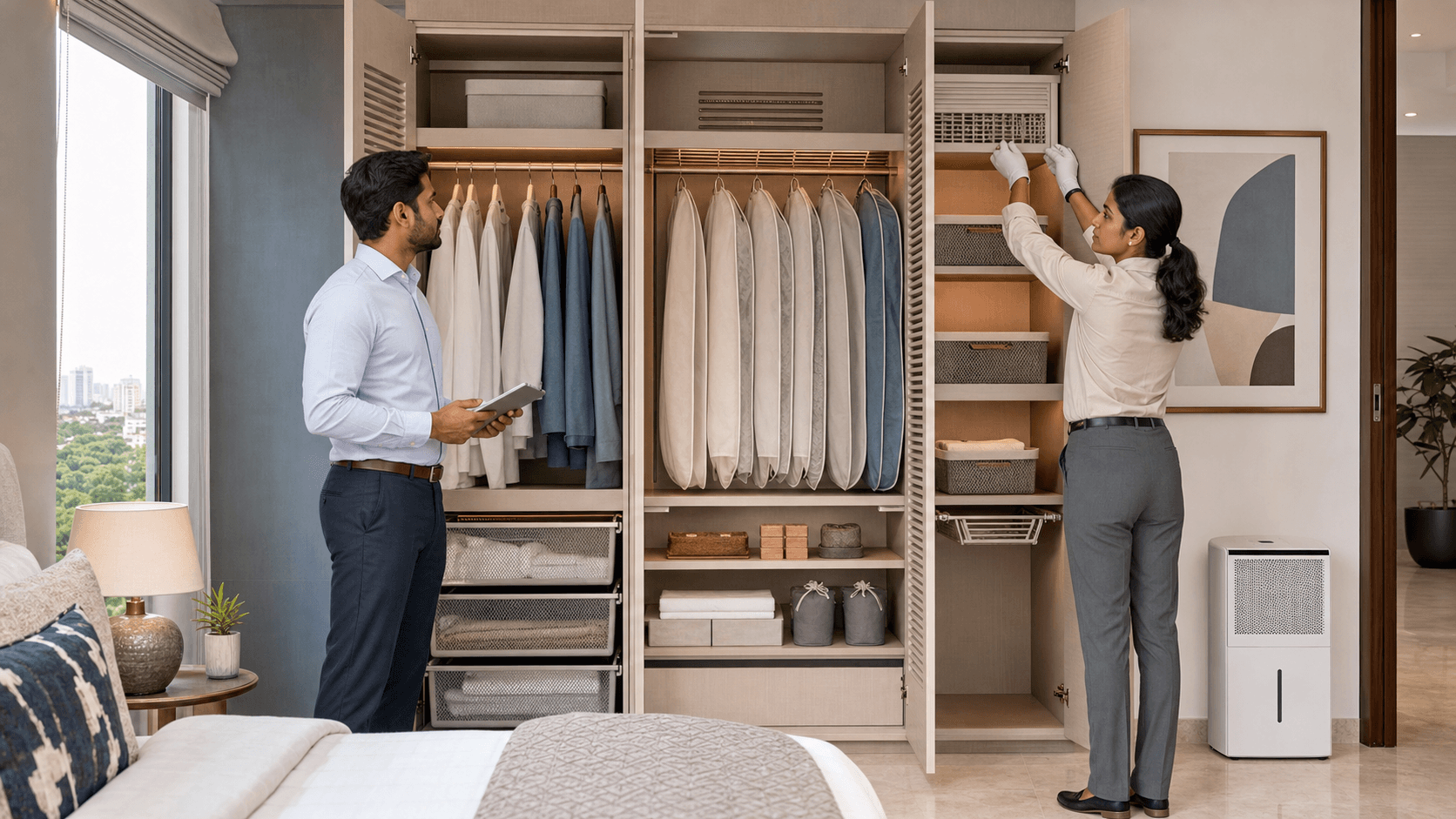
- Top and bottom airflow channels so hot, moist air can move up and out.
- A breathing gap behind the wardrobe, relative to the wall surface.
- The right use of louvred or profile shutters for specific zones only.
In older RCC buildings in areas like Velachery or Medavakkam, external walls can sweat more during monsoon. There, it helps to:
- Keep a sensible gap between wardrobe back and wall instead of pressing it tight.
- Place the most moisture-sensitive items, like silk saris and woollens, away from the wall-facing side.
- Use ventilation cutouts or profile shutters for those fabric zones, while keeping less sensitive zones fully closed for dust control.
In many newer township apartments in Thoraipakkam or Sholinganallur, walls are a bit more uniform, but corner wardrobes near bathrooms still need special attention. Ventilation cutouts are useful:
- In lofts above about 8 feet, where hot air gathers.
- In side panels facing a bathroom wall.
- In shoe sections, to reduce odour build-up.
They add less value in fully sealed middle sections that already stay quite stable, and too many openings can invite dust from main-road-facing bedrooms. That is where a system-driven method helps, balancing:
- Ventilation vs dust from traffic-heavy roads.
- Air gaps vs pest entry, using branded hardware and branded board systems to keep shutters aligned and tight where needed.
Planning these details early is easier and calmer than later retrofitting, changing swollen panels, or depending on portable dehumidifiers all the time. With clear, transparent pricing and instant, computer-generated quotations, you can see the cost of smarter ventilation upfront, instead of paying for the damage later.
Keeping Shoes and Pooja Logically and Respectfully Apart
In many compact apartments from Pallikaranai to Madipakkam, there is no separate shoe room or pooja room. One tall unit in the foyer or bedroom ends up doing everything: shoes, bags, keys, pooja items, helmets, random bills.
Mixing shoes and pooja items inside the same vertical section is usually a bad idea, both practically and emotionally:
- Odours from footwear spread faster in humid conditions.
- Pest risk is higher when flowers, kumkum, and camphor are stored near shoes.
- Many families feel uncomfortable even if it is technically the same cabinet.
Some practical zoning layouts we commonly execute in Chennai homes:
- For a 2BHK Foyer Unit: bottom ventilated pull-outs for shoes, middle closed drawers for keys and daily bits, top closed and lined zone for pooja with its own door and simple lighting.
- For Villas with a Pooja Niche: a slim, ventilated shoe cabinet near the entrance and a separate, fully closed pooja storage beside or under the mandir with no shared shutters.
- For Bedrooms Where the Family Prefers Pooja Inside: pooja storage in the loft or upper shelves of the wardrobe, and a small, separate shoe unit near the door rather than sharing columns.
Material choices matter here:
- Moisture-resistant boards and good-quality, branded hinges for shoe sections that are opened many times a day.
- Easy-clean laminates inside shoe drawers, useful for sandy or muddy footwear from ECR or beach-side areas.
- Heat- and stain-safe finishes around pooja lamps, oils, and agarbatti storage.
When this zoning is documented clearly at design stage, the team does not reach that awkward point on site where someone says, "There is an empty shelf over the shoe unit, let us put the pooja things there." Clear drawings, standardised checklists, and a structured process are meant to prevent exactly that kind of compromise.
Moisture-Safe Accessory Organisers for Chennai Wardrobes
Accessories suffer quietly in Chennai humidity. Common risk items are:
- Leather belts and wallets
- Watches
- Silver jewellery and temple jewellery
- Heirloom silk borders and dupattas
- Handbags
- Electronics like earphones and power banks that often land inside the wardrobe
Humidity-smart zoning inside a modular wardrobe in Chennai usually includes:
- Shallow drawers with partitions and soft, non-absorbent lining for jewellery and watches, kept away from wet external walls.
- Vertical hangers or pull-outs for belts and ties so air can move, rather than locking them inside tight boxes.
- Handbag cubbies with small ventilation gaps for weekly-use bags, and closed boxes with space for silica gel for long-term storage.
Moisture control should be built into the design, not added as a last-minute product:
- Plan fixed spots for rechargeable dehumidifier units or compact moisture absorbers that you can reach without emptying half the wardrobe.
- Avoid very absorbent drawer linings in the most humid-facing sections; choose branded, easy-clean liners that do not hold damp.
- Keep chargers, cables, and small gadgets in organisers with some breathing space so heat can escape while charging.
Poor accessory zoning often leads to sagging drawers, warped edges, and hardware issues. When the internal planning is correct and supported by a 15-year modular warranty with a clear, written replacement promise for the first 5 years, homeowners are not left worrying about failures every monsoon. If something still goes wrong, a defined 24-hour after-sales response ensures the issue is logged and addressed without long follow-up cycles.
A quick checklist for your current or future wardrobe:
- Do you have at least one low-humidity zone for jewellery and watches?
- Are belts and ties stored in a way that air can reach them?
- Is there a clear place for dehumidifiers or moisture absorbers?
- Are frequently used gadgets kept where heat can escape, not trapped in a corner?
- Are all these zones documented in your design drawings, or are they still "we will see on site" items?
Transparent Choices for a Humidity-Ready Wardrobe
Not every smart choice needs extra budget. Some things are almost free if done at the design stage:
- Shifting shelves and hanging space to open up air paths is usually cost-neutral when decided early.
- Shoe and pooja separation is more about layout than about fancy fittings.
- Simple ventilation planning in the right zones is often about cutouts and profiles, not big-ticket add-ons.
Costs usually show up when you add:
- Special shutters like louvred fronts or profile frames with perforation.
- Pull-out accessories for belts, ties, or shoes.
- Upgrades to more moisture-resistant boards or higher-grade edge-banding.
A simple comparison many Chennai homeowners use in their minds is:
Aspect | Standard Wardrobe | Humidity-Smart Wardrobe
---|---|---
Ventilation | Minimal, generic | Planned airflow paths for Chennai humidity
Shoes & Pooja | Often mixed in same unit | Clearly separated zones, documented in drawings
Accessories | Basic shelves | Low-humidity zones and breathable organisers
Effort in Monsoon | High; frequent airing and rearranging | Lower; system handles most humidity risks
Pricing Clarity | Lump-sum, many assumptions | Instant, line-by-line quotation for internals
Warranty | Often vague clauses | 15-year modular warranty, first 5 years 100% replacement
One common fear for IT professionals and villa buyers is, "Will more planning mean more surprise costs later?" A system-driven interior approach fixes most zoning decisions before anything goes into production, which reduces on-site improvisation. Instant, line-by-line quotations for internals, hardware brands, and accessories help you decide what to keep or skip with full clarity.
There is also a timeline angle. When zoning is frozen early, execution stays smoother even during the long monsoon stretch from June to November, when on-site changes are slower and more disruptive. Because we handle end-to-end turnkey execution, you have a single team accountable for design, manufacturing, installation, and after-sales, instead of coordinating multiple vendors during the rains.
FAQ: Wardrobes and Chennai Humidity
Q. Do I Always Need Special Boards for Chennai Humidity?
Not always. In some bedrooms with good cross-ventilation and internal zoning, standard branded boards with proper edge-banding perform well. For walls facing bathrooms or coastal-facing rooms along ECR and OMR, we usually recommend more moisture-resistant boards. This is discussed upfront with clear cost differences in your quotation.
Q. Will Ventilation Cutouts Make My Wardrobe Dusty?
If planned randomly, yes. We normally restrict cutouts to lofts, shoe zones, or wall-facing sides, and keep main clothes zones better sealed. The idea is to balance air movement with dust control based on your specific room orientation and floor level.
Q. Can I Fix Humidity Issues in an Existing Wardrobe?
To an extent. We can add selective cutouts, adjust internals, and plan dehumidifier spots, but it will not be as effective as designing it right from the start. For new homes in Chennai, it is better to freeze zoning and ventilation during the design stage itself.
Q. How Do I Know What Each Internal Accessory Will Really Cost me?
All our internals, hardware, and accessories come in an itemised, instant quotation. You can see the price impact of each pull-out, each profile shutter, or each board upgrade, so you can prioritise humidity-critical zones first and add other features only if they fit your budget.
A Calm, Structured Way to Handle Chennai Humidity
In the end, good wardrobe design in Chennai is not only about glossy shutters. It is about calm, thought-through interior zones that respect humidity, footwear habits, pooja practices, and the little things you store and forget until the next festival or office review meeting.
If you are moving into a new flat or villa in Chennai and feel unsure about how your wardrobes will behave after two or three monsoons, the next step is simple: sit with a clear zoning framework, an itemised quotation, and written warranty terms on day one. Once these are in place, the rest of the interior decisions become lighter, and you are not left managing surprises during the rains or after handover.
Transform Your Storage Space With Smart Wardrobe Design
Create a clutter-free, stylish bedroom with a custom modular wardrobe in Chennai designed to fit your space, lifestyle, and budget. At Interiors by DeX, we listen to how you live, then craft layouts, finishes, and internal accessories that make everyday organizing easier. Share your requirements with us today and let our team guide you from concept to final installation, or contact us to schedule a design consultation.