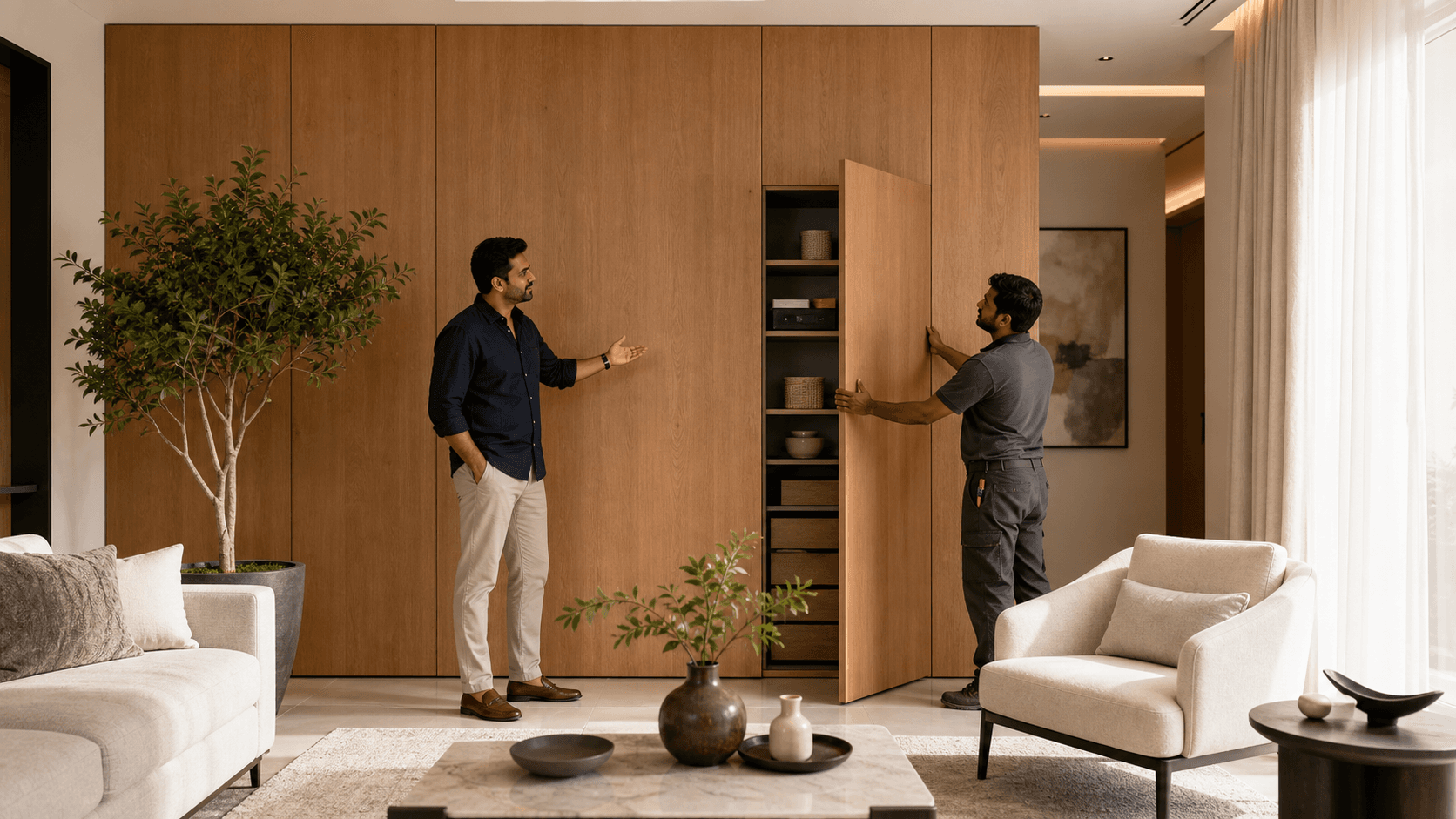
When Renovation Stress in Chennai Becomes a Pattern
Apartment renovation in Chennai often feels more stressful than booking the flat itself. New owners in places like Sholinganallur or Perumbakkam are usually juggling long workdays in the OMR IT corridor, family needs, and a renovation that keeps changing shape every week.
Many people face the same problems again and again, such as:
- Three different quotations for the same kitchen
- Vague start dates and even vaguer finish dates
- Confusing scope, with "this is extra" popping up at site
- A constant fear that once work starts, the final bill will shoot up
This repeat pattern tells us something. The real gap is not talent or creativity. Chennai has plenty of capable designers and contractors. The missing piece is a clear, reliable system that controls how design, costing, timelines, and execution fit together. When there is a system, your time is protected, decisions are simpler, and you are not forced to live at the site to keep things on track.
Why Chennai Renovations Go Off-Track so Easily
Chennai apartments and villas come with their own set of realities. Builder handover can get delayed, snag work stretches on, and association rules often decide how fast your interiors can move. In many gated communities in Thoraipakkam, Pallikaranai, ECR, or OMR, there can be rules on:
- Working hours for labour
- Using the service lift
- Materials allowed in the common areas
- Noise restrictions during certain parts of the day
Then there is the season. From around June, when the pre-monsoon showers begin, up to the later monsoon months, humidity and rain can affect material storage, drying times, and installation of moisture-sensitive finishes. If these are not planned in, delays and rework creep in easily.
Three big sources of uncertainty show up again and again:
- Scope ambiguity: Quotations that say "kitchen" or "wardrobe" as one line without telling you exactly what is included, what counts as extra, and what happens if site conditions vary.
- Design, execution disconnect: Designers promising one look, but drawings that miss tiny details, then site teams taking their own calls when they get stuck.
- Vendor fragmentation: Separate carpenter, separate false ceiling team, different modular supplier, separate electrician, each with their own timing and style of working.
For busy professionals in OMR and similar pockets, this has a real emotional cost. Constant calls from contractors, repeated site visits on weekends, and arguments over "extra" items can create serious decision fatigue. It is usually not because people are trying to cheat you. It is because there is no shared, written system that everyone follows from day one, with clear accountability for who is responsible for what.
Why Renovation Needs a System, Not a Hero Designer
Good design is important, but interior renovation in Chennai needs something more grounded: a system. By system, we mean fixed stages, each with clear outputs and documents, for example:
- Briefing and measurement
- Design and layouts
- Detailed Bill of Quantities (BOQ) and specifications
- Approvals on scope, design, finishes, and timelines
- Execution with site supervision, quality checks, and documented progress
- Handover with snag list and closure
- After-sales support with defined response times
When this structure is followed, work inside an apartment tower, where you only get a limited time window every day, becomes more predictable. Security, neighbours, and association rules stop being surprises, because they are factored into the plan from the start.
Pricing clarity is a big part of this. A detailed BOQ that itemises every kitchen cabinet, wardrobe, loft, and finish gives you visibility. When you get an instant quotation framework early, you also see whether your budget and requirements align, before you get too deep into design. This reduces the chances of late-stage cost shocks.
Responsibility is the other side of the coin. With multiple small vendors, each points at the other when something goes wrong. A turnkey model, where one team owns design, materials, labour, and timelines, gives you a single accountable face. That is especially helpful when you cannot be on site daily. You know who is answerable if there is a delay or a quality concern.
Turning Chaos Into a Practical Chennai Renovation Checklist
If you are a first-time homeowner, it helps to think of your renovation as a checklist, not a loose set of conversations.
Start with constraints:
- Society rules on working hours and lift use
- Parking and unloading points for materials
- Storage space inside the flat for boards, hardware, and tools
- Any expectations your neighbours or association have around noise and dust
Next, fix a realistic budget band. Instead of chasing the lowest number, think in terms of a range for modular interiors based on your flat size and needs. This keeps you grounded when you compare options and makes pricing discussions more transparent.
Illustrative Cost Structure for Chennai Homes
Costs will vary by project, but a simple structure helps you read quotations more clearly. For a typical Chennai apartment, you can view interiors in three buckets:
Cost Component
What It Covers
Notes
Core modular items
Kitchen, wardrobes, lofts, TV unit, basic storage
Usually priced per running foot / unit with defined brands and finishes
Site-specific works
Civil changes, electrical, false ceiling, painting
Can vary based on your tower, flat layout, and association permissions
Optional upgrades
Premium hardware, accessories, special finishes
Best taken as conscious choices, not surprises during execution
This kind of breakup keeps discussions honest. You can see where you are spending and where you are choosing to upgrade, instead of dealing with one opaque per-square-foot number.
Before work starts, always demand documentation:
- Final floor plan with all furniture marked
- 3D views where needed for better understanding
- Electrical and false ceiling layouts for every room
- A full material specification sheet listing brands and finishes
Some core documents and checkpoints you should insist on are:
- Detailed BOQ with quantities and unit rates
- Payment schedule tied to work milestones, not just dates
- Written warranty terms with duration, coverage, and exclusions clearly stated (no hidden clauses)
- A defined handover and snag list process with timelines for closure
Ask how after-sales is handled. Is there a 24-hour response promise? How are service requests recorded, tracked, and closed? In a city with the spread of Chennai, this matters as much as the original execution.
To cut decision fatigue, ask for curated material palettes instead of endless catalogues. Shortlisted combinations of laminates, finishes, and hardware can help you decide faster without feeling like you are missing out. Standardised, branded components also reduce scope for surprise substitutions at site and make future service simpler.
System-Backed Guarantees, Warranties, and Transparent Costs
Warranties in interiors often sound comforting at the start but feel vague later. There are usually three layers:
- Manufacturer warranty on boards, hardware, or appliances
- Contractor verbal promises, which are hard to recall or prove later
- A formal service warranty from the interior firm, if they offer one
Many homeowners only notice the gaps when a shutter sags or a drawer fails after a year or two.
A strong, transparent warranty on modular interiors should be written, long-term, and specific about what is covered. In practice, it should clearly list items like hinges, channels, board integrity, and edge banding, and avoid fine print that contradicts the verbal promise. A 15-year warranty on modular products, with the first 5 years covered by a 100% replacement guarantee on modular components, no questions asked, and with no hidden clauses, removes a huge layer of stress.
After handover, the question is not if you will need service, but when. In a large city like Chennai, with distance from OMR to North Chennai, a structured 24-hour after-sales response and a tracking system for service calls make a difference. It means you are not calling individual carpenters months later, hoping they pick up. You log a request, it is recorded, and there is a clear commitment on response and closure.
On costs, trouble usually comes from:
- Attractively low per-square-foot numbers that do not include shutters, hardware levels, or site work
- Incomplete scope that ignores things like extra electrical points, kitchen dado length changes, or false ceiling cutouts
A clearer way to think of costing is in three parts:
- Core modular items like kitchen, wardrobes, TV unit, and storage
- Site-specific works like civil changes, electrical work, false ceiling, and painting
- Optional upgrades like premium hardware, accessories, or special finishes
This structure, combined with a transparent pricing model and itemised BOQ, keeps discussions straightforward. When specifications are defined upfront and linked to branded products only, you usually spend wiser over the first 5 to 10 years. You are not paying twice, once for hurried work and again for early repairs.
Before you choose any renovation partner in Chennai, it helps to ask pointed questions:
- Can they show a sample BOQ for a flat similar to yours, say a 2BHK in Perungudi or a 3BHK in Sholinganallur?
- What exactly is the warranty, and is every clause given in writing with no hidden conditions?
- How do they handle mid-project changes in scope or design, both in terms of cost and timelines?
- Who will be your single point of contact during execution, and how often will you get updates?
Watch for red flags like very vague commitments, resistance to sharing details on materials, or unrealistic timelines that ignore association rules or seasonal slowdowns.
A system-driven firm will usually be comfortable showing you how they work. You will see instant quotations, structured drawings, brand names listed clearly, turnkey execution, and a defined after-sales process. All of this is meant to replace guesswork with clarity, so you know what will happen, when, and who is answerable.
FAQs for First-Time Homeowners in Chennai
When to Start Interior Planning After Booking a Flat in OMR or ECR
Ideally, start the planning and budgeting 3, 4 months before expected handover. This gives enough time for measurements, design, BOQ finalisation, and association approvals, without rushing decisions.
2. Are Per-Square-Foot Interior Rates Reliable for Chennai Apartments?
They are useful only as a rough starting point. For real comparison, ask for an itemised BOQ broken into core modular work, site work, and upgrades. This is where a transparent pricing model helps you see exactly what you are paying for.
3. How Do Gated Community Rules Affect My Project Timeline?
Working-hour limits, service lift slots, and material movement rules can reduce the effective work hours per day. A realistic timeline for a Chennai apartment should factor these in, rather than assuming full-day access.
4. What Warranty Should I Look for in Modular Interiors?
Look for a clearly written 15-year warranty on modular products, with the first 5 years covered by a 100% replacement guarantee on modular components, no questions asked. Ensure there are no hidden clauses and that hinges, channels, boards, and edge banding are explicitly listed.
5. Is Turnkey Execution Better Than Hiring Separate Contractors?
For busy homeowners, turnkey execution usually means clearer accountability, single-point coordination, and fewer gaps between design and site work. It also makes after-sales service more dependable, because one system tracks your project end to end.
A Calm Way to Approach Your Chennai Interiors
As a Chennai-based residential interior and turnkey execution firm, we at Interiors by DeX have built our approach around this need for clarity and accountability. Our focus is on premium apartments and villas, with branded modular products backed by a 15-year warranty, including a 100% replacement guarantee for the first 5 years on modular products, transparent pricing with instant quotations, and a defined 24-hour after-sales response system.
If you are a new homeowner in Chennai and want to understand how this kind of system might apply to your flat or villa, a simple next step is to review a sample BOQ and timeline for a home similar to yours. Even that comparison alone can make your renovation feel less like a gamble and more like a planned, controlled process.
Transform Your Chennai Apartment Into A Space You Truly Love
If you are ready to rethink your layout, upgrade finishes and create a home that feels tailored to you, our team at Interiors by DeX is here to help. Discover how our designers approach apartment renovation in Chennai with thoughtful planning, clear timelines and meticulous attention to detail. Share your ideas, budget and priorities and we will guide you through each stage so your renovation feels straightforward and well managed. To discuss your project and arrange a consultation, simply contact us.