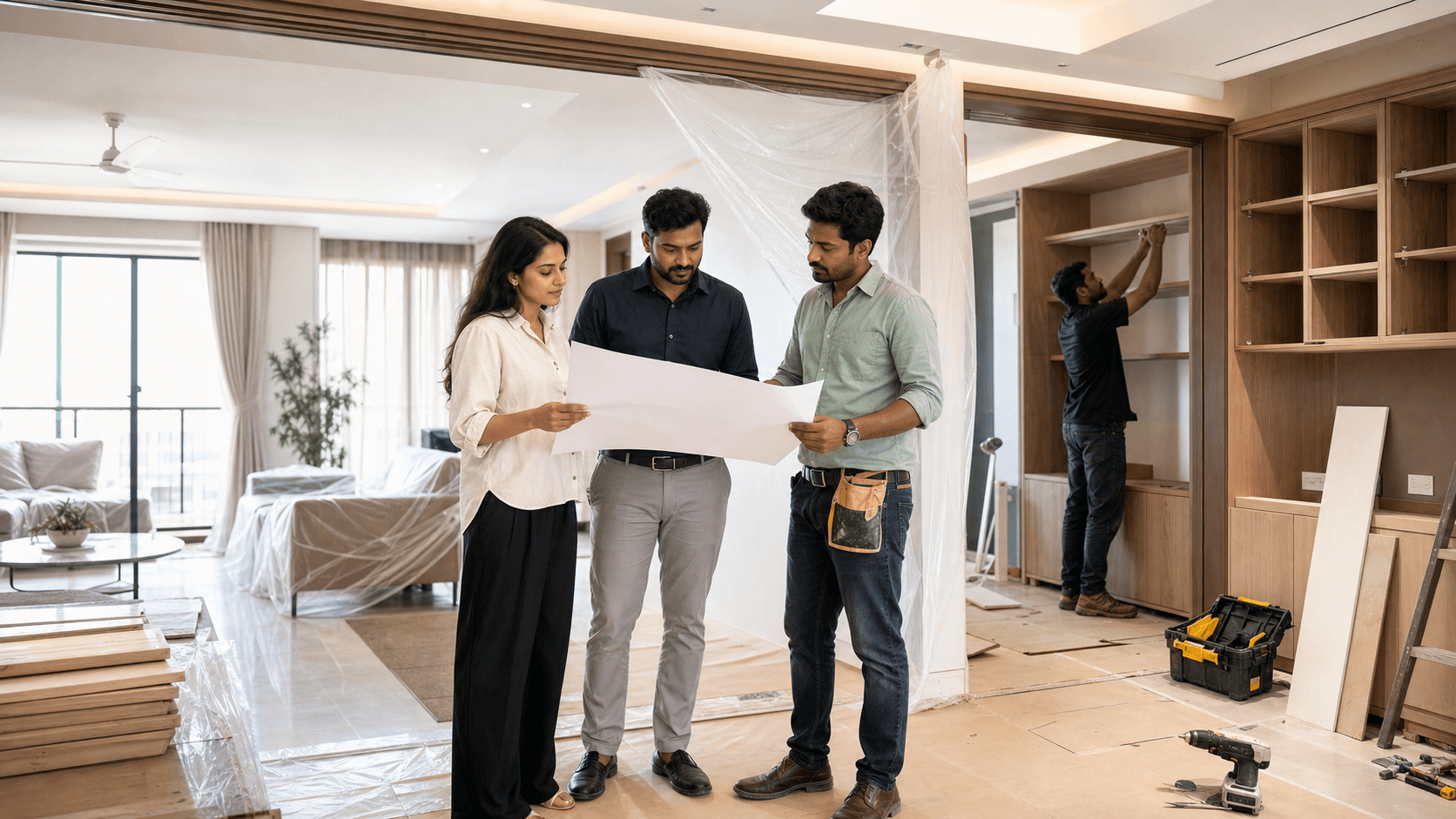
When a Phased Renovation Makes More Sense in Chennai
Interior work in a live apartment is hard on any family. You are trying to cook in a half-done kitchen, step around tools and dust, and you are never sure when workers will actually finish. On top of that, there is the quiet fear that once work starts, the bill will keep growing and the timeline will keep stretching.
Along OMR, ECR, and GST Road, many homeowners keep delaying interiors only because life does not pause. You may not be able to vacate the flat, kids are in school, and your company will not give you weeks of leave just to manage carpenters. A single big payment is also not always possible.
This is where a phased plan for apartment renovation in Chennai can help. Not as a second-best choice, but as a clear, structured way to balance budget, family routine and building rules without slipping into chaos. We will walk through when phasing is practical, what to finish first, how to avoid rework and how to keep accountability and transparency intact even when work is spread over many months.
Why Chennai Apartments Often Need Phased Planning
Chennai life pushes many people towards phasing, even if they did not plan it that way.
For many apartments along the IT corridor, common constraints look like this:
- Both owners working in IT with limited leave
- Elderly parents at home who cannot handle full-scale construction noise
- School schedules, exams and online classes to work around
Gated communities in Sholinganallur, Pallikaranai or Perumbakkam also have their own rules. You may face:
- Fixed working hours for noisy drilling
- Restrictions during exam periods
- Limited service lift timings for moving materials
Then there are the existing conditions of the home itself. Older apartments, or those closer to the coast along ECR, often have seepage or humidity issues. In those cases, you cannot jump straight to wardrobes and wallpaper. Civil repair and waterproofing must happen first, or your new finishes will suffer.
In newer handover flats in places like Perungudi or Navalur, the pattern is different. Owners often want to move in quickly with:
- A working kitchen
- Basic wardrobes
- Only the most urgent lighting and safety work
The nicer add-ons like wall panelling, bar units or detailed ceilings are pushed to a later phase when time and money are easier.
So when is a phased plan a good fit?
- Occupied apartments where vacating is not possible
- Staggered cash flow
- NRI owners who can only supervise in fixed visit windows
When is phasing risky? In very old buildings that need structural rectification. Doing half the work now and half later can mean repeating breaking, scaffolding, and services. Here, a full, tightly planned renovation done once is usually kinder on both cost and building health.
Core Zones to Prioritise in a Phased Renovation Plan
When you are staying in the flat during work, the order of execution matters almost as much as the design.
A simple priority sequence for most Chennai apartments is:
- Phase 1: Kitchen, essential wardrobes, electrical safety upgrades, basic lighting and fans
- Phase 2: Storage-heavy spaces like utility, crockery units, study or home office
- Phase 3: Aesthetic and comfort layers like false ceilings, wall panelling, loose furniture and decor
Why start with the kitchen and electricals? In compact kitchens across OMR and Medavakkam projects, good planning for storage, heat, and ventilation affects your day, every day. A clear hob, chimney and loft plan, along with proper shutters and hardware, makes the home feel livable even if the TV unit or wall panelling comes later.
In older areas like Adyar or T Nagar, electrical upgrades often move to the top of the list. With ACs in multiple rooms, induction cooking, washing machines and work-from-home setups, older wiring and MCBs can struggle. Cleaning this up early in the project means fewer surprises and safer loading later.
Some items simply cannot be split without inviting rework:
- False ceiling and lighting layout discussions should happen before modular installations. Otherwise, you may end up breaking new units to add concealed lights or rerun wiring.
- Plumbing and tiling changes in bathrooms must be bundled together. Reopening tiles or waterproofing layers in a later phase quickly eats into budget and time.
The key is to separate what is logically independent, and what is deeply linked to hidden services. This is where a system-driven interior process, with service drawings and a clear sequence, protects you from avoidable rework.
Cost, Time and What Phasing Really Changes
Phasing mainly changes when you pay, not what you pay for. A transparent view upfront avoids surprises later.
Spreading work into phases often helps with cash flow. But it is important to be clear that some overheads repeat when teams return:
- Site setup and protection
- Transport and loading of materials through lifts
- Labour mobilisation and closing formalities with the society each time
These repeats can make the total slightly higher than if everything was done in one continuous block. On the other hand, there are areas where phasing can actually help you spend better:
- You avoid impulse add-ons in the middle of chaos
- You have time to live in the space and see what storage and furniture you actually use
- You can plan decor and soft pieces with more clarity later
For a typical 2BHK apartment renovation in Chennai, a rough framework with transparent ranges could look like this, assuming uninterrupted access and mid-range finishes:
Phase / Scope
Typical Inclusions
Indicative Cost Range (Chennai, 2BHK)
Typical Timeline*
Phase 1: Kitchen & Core Wardrobes
Full modular kitchen, master bedroom wardrobe, one additional wardrobe if needed
INR 4.0 to 6.5 lakh
3 to 6 weeks for design, production and installation
Electrical & Lighting Safety Upgrades
Wiring corrections, MCB upgrades, basic light and fan fittings
INR 60,000 to 1.5 lakh (varies more in older buildings)
1 to 2 weeks; can extend if hidden issues surface
Phase 2: Storage-Heavy Areas
Utility storage, crockery unit, basic study / home office, book storage
INR 1.5 to 3.0 lakh
2 to 4 weeks, depending on complexity
Phase 3: Aesthetic & Comfort Layers
TV unit, simple false ceilings, wall panelling, niche shelving, bar unit
INR 1.5 to 3.5 lakh
2 to 4 weeks; dust-heavy work is usually lighter
*Timelines assume clear access, approvals in place and no major civil surprises. A written schedule with start and end dates for each phase is essential for accountability.
For accountability, each phase should have its own:
- Written, itemised scope of work with transparent pricing
- Start and end dates, including buffer days explained upfront
- Clear plan for how measurements, factory work and site work link like a calendar, not vague "after your payment we will see"
- Phase-wise payment milestones tied to measurable progress, not just dates
This kind of clarity on scope, cost and time reduces the usual anxiety about being overcharged or facing an open-ended timeline.
How to Structure a Practical Phased Plan in Chennai
Before speaking to any designer, a simple three-list method can reduce stress and decision fatigue:
- List A: Non-Negotiable Items Before Moving in or Before School Term
- Kitchen
- Basic wardrobes
- Electrical safety
- At least one finished bathroom
- List B: Important but Deferrable Work
- Study or home office
- Extra storage
- Guest room
- TV unit
- List C: Future Comforts and Visual Layers
- Panelling
- Bar units
- Niche shelving
- Ceiling design
This structure cuts decision fatigue. You do not need to freeze every finish for all three lists on day one. But you should lock the master plan:
- Layouts and furniture positions
- Electrical point locations
- Plumbing shifting, if any
When these are decided upfront, later phases can drop in without opening up finished work.
A system-driven approach with drawings, BOQs and a phased schedule lets you pause between phases without losing control. Every phase should have:
- Detailed, itemised scope with rate breakup
- Clear mention of what is excluded, so there are no assumptions
- Phase-wise warranty start dates, written clearly
- No hidden clauses like "warranty valid only if entire project is done in one go"
This kind of documentation not only protects you, it also makes roles and responsibilities very clear during execution and after handover.
Living Through Renovation in Chennai Weather and Conditions
Staying in the flat while work is ongoing is easier when planned around local conditions.
In the summer months, heat and dust build up fast. Simple tactics help:
- Temporary plastic partitions to keep some rooms cleaner
- Grouping noisy and dusty work into tight blocks instead of spreading it across weeks
- Being mindful of any known afternoon power cut patterns while planning machine-heavy work
During the monsoon season, large civil changes on external walls or open terraces are better avoided in low-lying and coastal pockets like Velachery and parts of Pallikaranai. Phasing helps you push those items to drier periods.
Family routine should shape the work chart:
- Children's bedrooms or study areas can be tackled during school breaks
- Noisy drilling around exam time is best avoided, especially in large gated communities where everyone is sensitive to noise
- Bathroom work should be sequenced so that at least one bathroom stays functional at any point
Good documentation during the project pays off later too. When every phase is backed by drawings, measurements and hardware specs, future tweaks are simpler. Clear service and warranty protocols make it easier to handle situations where, for example, your kitchen was installed in Phase 1 and a ceiling panel in the same room comes two years later. With a structured system, both can be handled without confusion on responsibility.
Frequently Asked Questions on Phased Renovation in Chennai
1. Does phasing always increase the total cost?
Not always, but some repetition is normal. You may pay slightly more in total for repeated setup, transport and labour mobilisation. On the other hand, you often avoid mid-project impulse changes and can take more measured decisions, which can balance the overall spend. The key is to have phase-wise BOQs and rate cards shared in advance, so you see where each rupee goes.
2. How do I avoid scope creep and surprise bills between phases?
Insist on written, itemised scopes for every phase, with inclusions and exclusions listed. Any change should be captured as a change order with its cost and timeline impact recorded before the work is done. This kind of system-driven interior process protects both sides from misunderstandings.
3. What is the right gap between phases?
There is no single right answer. Many Chennai homeowners complete Phase 1 before move-in, pause for a few months to settle into routine, and resume Phase 2 and 3 once school and work schedules are stable. The important part is to keep the master plan intact so that later phases do not disturb finished work.
4. How is warranty handled in a phased project?
Warranty should be phase-wise, with clear start dates and written terms. It should not be dependent on you doing the entire home at one stretch. No hidden clauses, and no ambiguity about whom to call for post-handover service. Ask for service protocols and contact points in writing.
5. Is phasing suitable for very old Chennai buildings?
If the building has structural or major civil issues, a single carefully planned renovation may be better. Breaking work into many small segments can mean repeated scaffolding, repeated permissions and higher risk to already weak structures. In such cases, use phasing more for finishes and furniture, not for core structural or waterproofing work.
What to Do Next
If you are living in or planning to move into an apartment along OMR, ECR or GST Road and are unsure whether to renovate in one shot or in phases, start with a simple exercise: make your three lists (A, B and C), note your realistic timelines around school and office, and set an approximate budget band for each phase.
Once you have that, speaking to a design partner becomes easier. You can ask very specific questions on transparent pricing, phase-wise timelines, warranty terms and after-sales support. A team that follows a system-driven approach will be able to map this into drawings, BOQs and a phased schedule, so you know exactly what will happen, when, and at what cost, without hidden conditions or surprises.
Transform Your Chennai Flat Into A Tailored Home
If you are ready to reimagine your space, we can guide every step of your apartment renovation in Chennai, from first sketch to final styling. At Interiors by DeX, we focus on thoughtful layouts, practical storage and finishes that suit your lifestyle and building constraints. Share a few details about your apartment and renovation goals and we will prepare a clear plan and timeline. To discuss your project or arrange a consultation, simply contact us today.